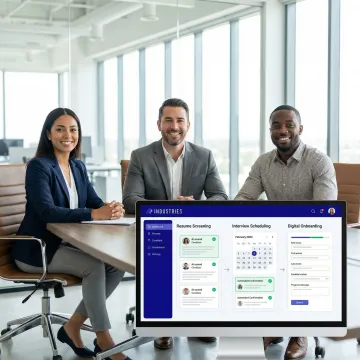
What is recruitment automation?
Recruitment automation is the use of AI and software to handle repetitive hiring tasks — such as resume screening, interview scheduling, candidate communications, and onboarding document collection — without manual intervention. It enables recruiting teams to process far more candidates in less time, reduce human error, improve candidate experience, and free recruiters to focus on high-value decisions like final evaluations and relationship building.
What is recruiting automation?
Recruiting automation refers to the systematic application of AI agents and workflow orchestration to streamline the end-to-end recruiting process. This includes automated sourcing, pre-screening interviews, skills assessments, background checks, and onboarding. Unlike standalone tools, a full recruiting automation platform like Assembly's orchestrates every step into a single workflow — from job order creation through to a candidate's first day — with full ATS integration and audit-ready documentation.
How does AI screening reduce time-to-hire?
AI screening agents review every resume against your defined criteria within seconds of submission, generating ranked shortlists with evidence-based scores. Simultaneously, automated scheduling tools book qualified candidates for interviews without recruiter involvement. Together, these capabilities compress what typically takes days of manual effort into hours — allowing high-volume recruiting teams to move qualified candidates through the pipeline before competitors do.
Can Assembly's automation integrate with our existing ATS?
Yes. Assembly Industries connects with 35+ systems including major ATS, HRIS, ERP, VMS, and CRM platforms. The implementation team encodes your ATS data model, scoring rubrics, and compliance requirements during setup — so candidate records, assessment scores, and status updates flow automatically into your existing system without requiring your team to manage a separate tool or duplicate data entry.
Does recruiting automation work for high-volume and seasonal hiring?
It is particularly effective for high-volume and seasonal scenarios. Assembly's agentic shift scheduling handles the full lifecycle for temporary, seasonal, and event-based workforces — including recruitment, onboarding, training, shift assignment, real-time backfill, and cancellation management. Workers interact via SMS or voice at any hour, while managers receive dashboards and escalations only when human decisions are genuinely needed.
How does Assembly handle candidate communications in multiple languages?
Assembly Industries Talk engages candidates via voice, SMS, and web in 74+ languages, conducting structured pre-screening interviews and skills assessments around the clock. This capability is especially valuable for staffing firms placing workers in diverse roles across the United States, ensuring every candidate receives a consistent, professional interaction regardless of their preferred language — with scores and summaries automatically fed back to your ATS.
Is candidate data kept secure and compliant?
Assembly operates on a SOC2 compliant security architecture with virtualized execution environments, auto-scaling infrastructure, and comprehensive audit logging across every workflow. All candidate interactions, document collections, and assessment results are tracked with full traceability — giving your compliance and legal teams the audit-ready documentation they need without any manual record-keeping effort from your HR or recruiting staff.
What is included in Assembly's recruitment automation implementation?
Every deployment includes a detailed process assessment, custom AI agent development, expert human oversight, and continuous improvement — not just platform access. Assembly's implementation team encodes your specific scoring rubrics, compliance requirements, and ATS configurations, then remains engaged post-launch to refine performance. The second automation project ships 30–40% faster, and subsequent projects faster still, as your infrastructure compounds over time.