Introduction
Modern hiring teams are drowning in applications. The average job posting now attracts 257.6 applications, up from 207.2 in 2024, and recruiters are handling 93% more applications than in 2021.
The surge isn't just about more candidates — AI-generated resumes are flooding inboxes at scale. 84% of HR leaders report heavier workloads due to AI-optimized applications, and ironically, a technology meant to help candidates is slowing the hiring process down.
Recruiters spend an average of 1 minute 34 seconds reviewing each resume, yet only 8% of applicants advance past initial screening. That means 92% of review time goes toward candidates who will never move forward.
Yet most organizations still treat automated candidate screening as a "nice to have" rather than a core process control. This article covers five specific, measurable reasons why automated screening makes hiring faster, fairer, and more scalable — with a focus on outcomes, not features.
Key Takeaways
- Uses AI and predefined criteria to evaluate and rank applicants — no manual resume-by-resume review required
- Reduces time-to-fill by up to 50% by accelerating initial review and freeing recruiter time for strategic work
- Improves hiring quality through consistent, objective evaluation that reduces unconscious bias
- Scales with volume—500 or 5,000 applications cost the same to process
- Drives sharper job definitions and raises hiring standards across teams
What Is Automated Candidate Screening?
Automated candidate screening is the use of technology—typically AI, machine learning, and rule-based logic—to evaluate and triage job applications as they arrive, categorizing candidates into priority buckets before a recruiter reviews them.
It's applied primarily at the top of the hiring funnel, replacing or augmenting the first manual pass on resumes, cover letters, and pre-screening questionnaire responses. Modern tools go well beyond keyword matching. They evaluate candidates across multiple dimensions using semantic analysis and structured evaluation frameworks:
- Skills fit — matching demonstrated abilities to role requirements
- Experience patterns — identifying relevant career trajectories, not just job titles
- Role fit signals — surfacing contextual cues that indicate likelihood of success
The goal is to ensure the strongest candidates reach recruiters faster, so recruiting teams can spend their time on decisions that actually require human judgment, relationship building, and strategic thinking.
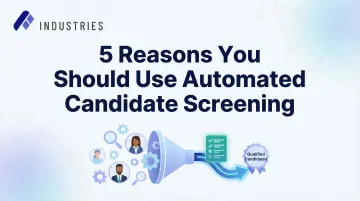
5 Reasons You Should Use Automated Candidate Screening
Each reason below maps to a measurable operational outcome. Track even two or three of these KPIs before and after implementing automated screening, and the ROI case builds itself.
Reason 1: It Dramatically Reduces Time-to-Fill
Time-to-fill is one of the most critical and costly KPIs in talent acquisition. Automated screening compresses the most time-intensive part of the funnel—the initial review—from days or weeks of recruiter work to near-instantaneous triage.
Talent teams using AI tools save roughly 20% of their work week—the equivalent of one full day. When the national average time-to-fill hovers between 63-68 days, and AI can reduce that timeline by up to 50%, the operational impact is substantial.
The best candidates are off the market in 10 days. A faster top-of-funnel means top candidates receive responses sooner, reducing the risk of losing them to competitors with faster processes. Candidates are 38% more likely to accept an offer when they've had a positive experience, and willingness to refer others increases 108% when employers make timely offers within one week.
KPIs impacted:
- Time-to-fill
- Time-to-first-contact
- Offer acceptance rate
- Candidate referral likelihood
This matters most for high-volume roles, positions with short candidate availability windows, and organizations running multiple concurrent openings where recruiter capacity is the real bottleneck.
Reason 2: It Improves Quality of Hire Through Consistent Evaluation
Manual screening is inherently inconsistent. A recruiter reviewing 200 resumes over two days will apply different standards to the first 20 than the last 20, and unconscious bias will influence decisions even when reviewers try to be objective.
Research shows that resumes with White-sounding names receive 50% more callbacks than identical resumes with Black-sounding names. Women have 69% lower chances of being interviewed for gender-neutral jobs compared to equally qualified men when human recruiters rely on gender stereotypes.
Automated screening applies the same defined criteria to every application, creating a structured, repeatable evaluation framework. When properly configured and audited, it reduces the gender gap in screening by 43 percentage points.
Consistency in early-stage evaluation means the shortlist reflects actual role requirements rather than recency bias, reviewer fatigue, or name recognition. That consistency also closes another gap: structured evaluations prevent AI-polished resumes from masking thin qualifications, so genuinely capable candidates aren't buried under well-formatted noise.
KPIs impacted:
- Quality of hire
- Diversity of shortlist
- Hiring manager satisfaction with candidate quality
- Reduction in mis-hires
This matters most for high-volume roles, organizations with diversity hiring goals, and teams that have seen a mismatch between screened candidates and actual on-the-job performance.
Reason 3: It Frees Recruiters to Focus on High-Value Human Work
When automated screening handles initial triage, recruiters reclaim significant hours per week previously spent on low-signal, high-volume review. 46% of firms report AI cut their screening time in half or better, and recruiters redirect those time savings primarily toward candidate screening (35%), skill assessments (26%), and relationship building (39%).
That time reclaimed isn't just an efficiency number—it changes how recruiters show up at the interview stage. Those who aren't exhausted by resume triage arrive better prepared, more focused, and with richer context on each shortlisted candidate.
34% of recruiters spend up to half their week filtering spam and junk applications. This isn't just inefficient—it's a primary driver of recruiter burnout and turnover, which costs organizations 1.5-2x the employee's salary to replace.
KPIs impacted:
- Recruiter capacity utilization
- Interviews-per-hire ratio
- Hiring manager satisfaction
- Recruiter retention and satisfaction scores
This matters most for lean recruiting teams managing multiple open roles simultaneously, and enterprise HR functions being asked to scale output without adding headcount.
Reason 4: It Scales With Hiring Volume Without Proportional Cost Increases
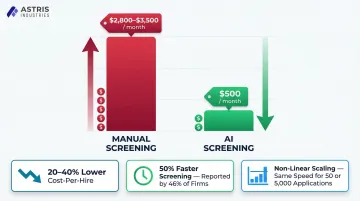
Manual screening scales linearly—doubling the applications doubles the recruiter time required. Automated screening is non-linear; the system evaluates 50 or 5,000 applications with the same speed and without additional labor cost.
Teams report 20-40% lower cost-per-hire when AI automates screening and scheduling. Savings come from faster time-to-fill, reduced agency dependency, and more efficient job board targeting. One analysis found that manual screening of 500 applications costs $2,800-$3,500 monthly in direct labor, while AI screening costs $500—an 82-86% reduction.
Scale also amplifies risk, not just cost. Manual screening at volume means more missed qualified candidates, inconsistent criteria application, and greater compliance exposure. The EEOC treats algorithmic decision-making tools as employment selection procedures under Title VII, requiring strict adverse impact auditing. Automated systems with proper logging and transparency provide better audit trails than manual review notes.
KPIs impacted:
- Cost-per-hire
- Screening throughput
- Recruiter hours per filled role
- Compliance audit readiness
This matters most for enterprise hiring at scale, high-volume roles in logistics, retail, healthcare, and customer service, and any organization where hiring volume fluctuates—such as retail's seasonal spikes that add 492,000 jobs in Q4.
Reason 5: It Forces Better Job Definition and Elevates Hiring Practices
For automated screening to work well, organizations must be precise about what they're screening for. This forces hiring managers and HR teams to write clearer job requirements, define success criteria upfront, and align on what "qualified" actually means—work that improves the entire hiring process, not just the automated stage.
Employees hired based on skills stay 9% longer compared to those hired through traditional credential-based methods. Realistic Job Assessments reduce attrition by 55%, and the candidate expectation gap—driven by poorly defined job descriptions—is the #1 driver of high attrition, with nearly 30% of employees leaving within the first 90 days.
Teams that invest in well-defined screening criteria tend to see compounding returns over time:
- Better alignment between roles and hires
- Clearer onboarding benchmarks
- Stronger performance data
- 90-day retention rates above 85% (the benchmark threshold)
- Average time-to-productivity of 28 weeks or less
KPIs impacted:
- Job specification quality
- Offer-to-acceptance alignment
- 90-day retention rate
- New hire ramp time
This matters most for organizations with historically high turnover, teams rolling out new roles or job families, and enterprises scaling into new markets or functions.
What Happens When Automated Screening Is Missing or Ignored
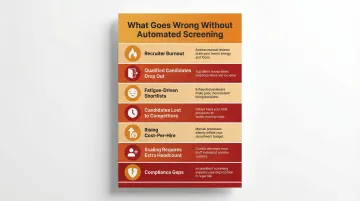
Relying on manual screening at scale creates predictable failure modes:
Common breakdowns include:
- Recruiters burning out on high-volume, low-signal work
- Qualified candidates dropping out after long delays in the initial review queue
- Shortlists that reflect reviewer fatigue rather than actual role fit
- Strong candidates lost to competitor offers while still waiting for a first response
- Cost-per-hire climbing without any improvement in hire quality
- Difficulty scaling during peak periods without proportional headcount increases
- Compliance gaps when screening decisions can't be traced or explained
At any meaningful application volume, these aren't edge cases. They're the expected outcome when manual review handles work that automation is built to do.
How to Get the Most Value from Automated Candidate Screening
How to Get the Most Value from Automated Screening
Automated screening delivers its highest value when set up with clear, role-specific criteria and reviewed regularly. Vague inputs produce vague outputs.
Define Criteria Upfront
Define what "qualified," "maybe," and "unsuitable" looks like for each role before automating the triage. Build in feedback loops where hiring managers can validate shortlist quality over time and refine criteria as roles evolve.
Maintain Human Oversight
Automation works best as a support layer, not a replacement for human judgment. The screening system should surface and prioritize candidates, but human reviewers should retain control over final advancement decisions.
The most effective model pairs automation for volume and consistency with human judgment for evaluation and relationships. Assembly Industries, for example, structures its HR automation this way: AI handles triage at scale, while human reviewers own final decisions and candidate relationships.
Monitor Outcomes Consistently
Treat automated screening as an ongoing practice, not a one-time setup. Track these metrics regularly to assess and improve performance:
- Time-to-fill: Is the pipeline moving faster since automation?
- Shortlist quality: Are hiring managers advancing a higher percentage of screened candidates?
- Downstream hire performance: Are automated shortlists predicting on-the-job success?
Criteria should evolve as roles change. The teams that get the most from automated screening are the ones that refine it continuously.
Conclusion
Automated candidate screening gives recruiters control over where their time goes, applies consistent evaluation criteria at scale, and builds a hiring process that produces predictable, high-quality outcomes.
Each of the five reasons compounds when applied consistently over time:
- Faster time-to-fill improves candidate experience, which lifts offer acceptance rates
- Consistent evaluation raises quality of hire and strengthens diversity outcomes
- Freed recruiter capacity enables deeper relationship building with top candidates
- Scalable infrastructure drives down cost-per-hire as volume grows
- Better job definition at intake reduces early-stage attrition and improves retention
As application volume continues to grow and AI-generated applications become more common, organizations that invest in automated screening now are building a durable competitive edge in talent acquisition—one that improves recruiter experience, candidate quality, and hiring efficiency simultaneously. Treat automated screening as an ongoing operational discipline, not a one-time tool deployment.
Frequently Asked Questions
What does automated candidate screening mean?
Automated candidate screening uses AI and predefined criteria to review, categorize, and prioritize job applications as they arrive—replacing manual resume-by-resume review with structured, consistent triage that surfaces the most qualified candidates faster.
How to choose the right ATS?
Look for customizable screening criteria, transparent decision logic, ATS integration, and bias monitoring features. Prioritize tools that support human oversight rather than fully automated rejections, and confirm the vendor provides audit trails for compliance.
What are the 5 C's of recruitment?
The 5 C's framework (Competency, Character, Culture fit, Compensation, and Commitment) gives recruiters a holistic evaluation model. Automated screening can assess several of these criteria in the initial triage stage through skills assessments and structured questionnaires.
What is the 70/30 rule in hiring?
The 70/30 rule suggests spending roughly 70% of recruitment effort on proactive sourcing and pipeline building, and 30% on reactive inbound screening. Automated screening frees up recruiter time to shift more effort toward proactive sourcing, improving the quality and diversity of candidate pipelines.
What is the 80/20 rule in recruiting?
The 80/20 rule suggests roughly 80% of quality hires come from 20% of sourcing channels or candidate profiles. Automated screening identifies that top 20% faster by consistently filtering for high-quality signals, so recruiters spend time on channels that actually convert.
Does automated candidate screening introduce bias?
AI screening tools can replicate biases in training data if not properly configured and audited. Responsible implementations use transparent decision logic, regular bias audits against EEOC guidelines, and human review at critical decision points to keep the process fair and compliant.