Introduction
HR teams face mounting pressure from every direction. HR workloads are projected to rise 9% in 2026 while staffing remains flat, forcing organizations to bridge capacity gaps with technology. At the same time, 63% of employers cite skill gaps as the primary barrier to business transformation, and only 29% expect talent availability to improve through 2030. Against this backdrop, AI and automation in HR has moved from experimental to essential. The category spans machine learning, generative AI, AI agents, and robotic process automation—applied across the full employee lifecycle to reduce manual work and improve decision-making.
Understanding where this is heading is no longer optional. Organizations that lag on adoption face compounding disadvantages:
- Slower hiring cycles that cost them top candidates
- Administrative bottlenecks that drain HR capacity
- Reactive workforce planning with no predictive signal
- Employee experiences that fall short of modern expectations
This article breaks down where AI and automation are already delivering results in HR, where adoption is accelerating, and what a strategic rollout actually looks like.
Key Takeaways
- AI spans the full employee lifecycle: sourcing, onboarding, performance management, and offboarding
- Generative AI and agentic AI are accelerating HR adoption, pushed further by rising labor costs and the shift toward data-driven decision-making
- Operational efficiency gains, reduced administrative burden, and personalized employee experiences are the biggest impacts
- Leading organizations are replacing point solutions with unified AI-and-human orchestration across HR functions
- Agentic AI will manage end-to-end HR workflows within 1–3 years, with humans overseeing judgment-intensive decisions
Key Trends in AI and HR Automation
AI-Powered Talent Acquisition
Recruiting has become the most visible proving ground for HR AI. Enterprise deployments now automate resume screening, candidate sourcing across job boards and professional networks, interview scheduling, and job description generation—compressing time-to-hire by roughly 50% in most implementations.
Wood plc reduced average time-to-hire from 45.1 days to 21.1 days after deploying AI within Oracle HCM, representing a 53% productivity increase. Capita cut time-to-hire by 43% through Workday's AI tools, enabling recruiters to spend more time serving customers rather than processing applications. Hilton's custom chatbot saved an estimated $2,000 of labor per hire in high-turnover markets by enabling same-day interview scheduling.
Key benefits beyond speed:
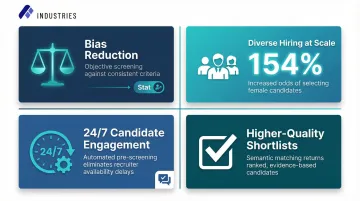
- Bias reduction through objective screening: AI evaluates candidates against consistent criteria, reducing unconscious bias in early stages
- Diverse hiring at scale: Research shows that diversity-focused AI explanations increased the odds of selecting a female candidate by 154% when properly implemented
- 24/7 candidate engagement: Automated pre-screening and scheduling eliminate delays caused by recruiter availability
- Higher-quality shortlists: Semantic matching returns ranked candidates with evidence, not just keyword matches
The result is recruiters who spend less time filtering resumes and more time building relationships with candidates who actually fit the role.
Intelligent Onboarding and Employee Lifecycle Management
Onboarding has long been a document-chasing exercise. AI transforms it into an accelerated assimilation process that reduces time-to-competency while ensuring consistent experiences across roles and locations.
AI assistants and agentic AI now handle new hire orientation, document processing, account setup, and personalized training delivery autonomously. A Forrester study found that automated workflows get newly onboarded employees to full productivity two weeks faster, equating to a $9.3 million financial benefit over three years for a composite enterprise.
Real-world adoption includes:
- Virtual orientation assistants collect documents, obtain e-signatures, and deliver policy acknowledgment 24/7 in multiple languages
- Zero-touch provisioning provisions devices and assigns role-based access controls before day one
- Adoption monitoring flags new hires needing additional support before issues compound
- Personalized training delivery scales from individual onboarding to organization-wide compliance programs with automatic scoring and certificate generation
Platforms like Assembly Industries apply this model directly: AI agents handle document collection and provisioning end-to-end, while human oversight teams manage exceptions and compliance edge cases — so new hires complete documentation in minutes, not days.
Predictive Analytics and Continuous Performance Management
Traditional performance management is inefficient by design. Companies spend an average of 210 hours per manager per year on performance activities, yet only 14% of employees strongly agree that reviews inspire improvement.
Predictive analytics shifts HR from reactive to proactive talent management by using historical workforce data to forecast attrition risk, identify skills gaps, and inform succession planning. Organizations combining internal metrics with external signals report an average $13.01 return for every $1 invested in workforce planning analytics.
However, execution lags ambition: 78% of organizations plan to use predictive analytics for workforce planning, yet only 6% have reached predictive maturity.
Continuous feedback is replacing annual reviews:
- Organizations switching from annual reviews to continuous feedback saw a 15% improvement in employee performance on average
- 20% boost in engagement scores
- AI-enabled systems provide real-time performance conversations and pattern analysis
- Managers receive actionable insights rather than administrative burdens
That shift from annual snapshots to continuous signals is what makes the performance data actually useful — and it sets the stage for the broader operational model HR teams are now building around it.
AI-First, Human-in-the-Loop HR Operations
The most significant shift in enterprise HR automation is the move from automating individual tasks to orchestrating entire workflows — with AI agents handling execution and human experts managing oversight, judgment, and exceptions.
Organizations that deploy AI without clear human accountability face real consequences. Workday's research reveals that while 85% of employees save one to seven hours weekly using AI, nearly 40% of that time is lost to rework — correcting errors, rewriting content, and verifying outputs. Only 14% of employees consistently get clear, positive net outcomes from AI.
The hybrid orchestration model addresses this gap:
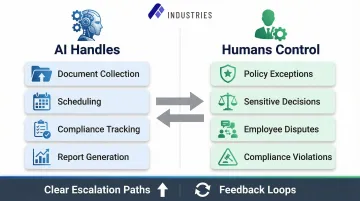
- AI handles repeatable administrative work: Document collection, scheduling, compliance tracking, report generation
- Humans maintain control at escalation points: Policy exceptions, sensitive decisions, employee disputes, compliance violations
- Clear escalation paths: Documented triggers determine when tasks move from AI to human review
- Feedback loops: Human corrections continuously improve AI agent performance
Assembly Industries is built specifically for this model: their platform combines AI agent orchestration with expert implementation teams that encode business context, compliance requirements, and escalation protocols from the start. The outcome is measurable process improvement, not just tool deployment.
What's Driving HR's Shift Toward AI Adoption
The transition toward AI in HR is driven by converging pressures that make automation a strategic imperative rather than a nice-to-have.
Technology Has Matured Faster Than HR Can Keep Up
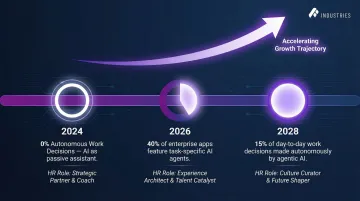
The rapid maturation of generative AI, agentic AI, and natural language processing has made it feasible to automate complex, language-heavy HR tasks that rule-based automation previously couldn't handle. By 2026, 40% of enterprise applications will feature task-specific AI agents, shifting AI from passive assistant to autonomous workflow orchestrator.
Cost Pressure Is Making Automation Non-Optional
Rising labor costs and lean HR team sizes are pushing organizations toward automation as a hard efficiency lever. Digital World Class HR organizations have increased technology spending to 200% of their peers, resulting in labor costs that are 44% lower. AI-enabled HR functions cut administrative overhead by deflecting routine inquiries and automating transactional processes at scale.
Talent Gaps Are Forcing HR to Do More With Less
HR teams are chronically understaffed relative to organizational growth. Automation lets smaller teams support larger workforces without proportional headcount increases — which matters when the pipeline itself is shrinking. The World Economic Forum reports that 63% of employers cite skill gaps as the primary barrier to business transformation, and only 29% expect talent availability to improve between 2025 and 2030.
Employees Expect Consumer-Grade HR Experiences
Today's workforce expects fast, personalized, on-demand HR support — the kind they get from consumer apps. Legacy manual processes can't deliver this at scale. Specific expectations now include:
- 24/7 access to policy and benefits information
- Instant answers to routine HR questions
- Self-service capabilities that bypass ticket queues entirely
- Personalized responses, not generic templates
How AI and Automation Are Impacting the HR Industry
AI and automation are driving measurable changes across HR operations, business strategy, and the HR workforce itself. The magnitude of impact grows with implementation maturity.
Operational Impact
AI has reclaimed thousands of hours previously spent on administrative tasks such as data entry, policy Q&A, compliance tracking, and report generation—freeing HR professionals to focus on higher-value, human-centric work.
Quantified productivity gains:
- Over 77,000 hours saved on HR requests through ServiceNow HRSD
- Up to 30% HR labor efficiencies regained; 17,000 hours of HR time saved
- 85% faster query resolution—declining from 12.0 minutes to 1.8 minutes via SAP chatbot
- 35% improvement in user satisfaction scores via 24/7 availability
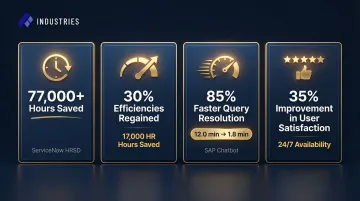
24/7 AI-powered self-service portals now resolve routine employee queries without human intervention, improving response times and employee satisfaction while deflecting Tier-1 administrative burdens from HR teams.
Business Impact
AI repositions HR from a cost center to a strategic business partner. Workforce intelligence and predictive analytics allow HR to inform talent strategy, headcount planning, and organizational design with data rather than intuition.
The cost of disengagement vs. the value of experience:
- Global employee engagement fell to 21%, with lost productivity costing the global economy $438 billion
- Top-quartile business units achieved 23% higher profit than bottom-quartile units
- 18% reduction in turnover for high-turnover organizations
- 43% reduction in turnover for low-turnover organizations
Organizations with mature HR AI adoption show measurable improvements in retention and hiring efficiency. Early adopters report up to a 50% reduction in employee attrition through proactive scenario modeling and early interventions enabled by external signal monitoring.
Workforce Impact
AI automates repetitive HR tasks but increases demand for HR professionals with data literacy, AI prompt skills, and change management capabilities—it reshapes roles rather than eliminating them.
Surging demand for AI literacy:
- Jobs requiring AI literacy grew 70% year over year
- Two-thirds of organizations (67%) have not been proactive in training employees to work alongside AI
That skills gap is accelerating the creation of entirely new HR roles. As organizations deploy AI more broadly, HR teams are taking direct ownership of AI governance—a responsibility that didn't exist five years ago.
HR's new governance roles:
- Digital Ethics Advisors — build AI safety systems and ensure regulatory compliance
- AI Decision Designers — audit algorithms for bias and maintain human accountability in automated decisions
Beyond hiring for these roles, HR teams must manage bias auditing, data governance, and ensuring AI-driven decisions meet both compliance and DEI standards.
Future Signals for AI in HR
The next 1–3 years will bring fundamental shifts in how HR technology operates and what it can deliver.
Agentic Workflows Take Over Execution
Agentic HR workflows represent the most significant near-term shift. AI agents will move beyond answering questions to autonomously completing multi-step HR processes end-to-end: managing the full promotion cycle, running compliance checks, or orchestrating onboarding across systems.
Gartner forecasts that 15% of day-to-day work decisions will be made autonomously through agentic AI by 2028, up from none in 2024. Humans will set parameters and review exceptions rather than execute tasks—shifting HR from running automation tools to overseeing end-to-end task execution.
Hyper-Personalization Becomes the Baseline
Hyper-personalization at scale will become a standard expectation rather than a premium feature. Within 1–3 years, AI will deliver individualized career development paths, learning recommendations, and total compensation modeling for every employee.
Organizations like Mphasis already use AI-powered engines that analyze an individual's track record, nudge them toward aligned learning, and autonomously suggest internal job postings once certified. The result is a continuous loop connecting skills, projects, and business demand.
Regulatory Governance Becomes a Core HR Skill
Regulatory and ethical AI governance will become a defining HR competency. As AI is used in hiring, performance evaluation, and workforce planning, governments and enterprises are developing frameworks around algorithmic accountability, bias auditing, and explainability.
Key regulatory deadlines:
- The EU AI Act explicitly classifies HR and employment AI systems as "high-risk", mandating strict bias audits and human oversight by August 2, 2026
- Deployer obligations require HR teams to enforce human oversight, conduct Fundamental Rights Impact Assessments, and keep logs for at least six months
- The EU AI Act has extraterritorial reach—if a US company uses AI-powered HR tools affecting anyone in the EU, the regulation applies
HR teams that build audit trails, bias review processes, and human oversight protocols now will be better positioned when deadlines hit—rather than scrambling to retrofit compliance into systems already in production.
Conclusion
AI and automation are fundamentally reshaping HR—not as a future possibility but as a present-tense transformation already producing measurable outcomes for early adopters. The numbers are concrete:
- Organizations deploying AI in talent acquisition cut time-to-hire by 40–50%
- Automated onboarding gets new hires to full productivity two weeks faster
- Predictive analytics reduces attrition by up to 50% through proactive interventions
Organizations that move from fragmented point solutions toward intelligent, outcome-focused orchestration of AI and human expertise will be best positioned to attract talent, reduce costs, and build resilient workforces as automation reshapes competition across industries. Strategic implementation—coordinated across recruiting, onboarding, and workforce planning—is now a competitive requirement, not an IT project. Regulatory deadlines are tightening, and the gap between early adopters and laggards is already measurable.
Frequently Asked Questions
What is AI and automation in HR?
AI and automation in HR refers to applying technologies like machine learning, generative AI, AI agents, and robotic process automation (RPA) to automate and manage HR functions across the employee lifecycle—from recruiting and onboarding to performance management and workforce planning.
What is the key benefit of AI in HR automation?
The primary benefit is freeing HR teams from repetitive administrative tasks so they can focus on strategic, human-centric work. It also delivers faster, more consistent, and more personalized experiences for employees at scale.
What HR tasks can be automated with AI?
Commonly automated tasks include resume screening, interview scheduling, onboarding workflows, policy Q&A, payroll processing, benefits administration, performance tracking, compliance monitoring, and exit interviews.
What are the biggest challenges of adopting AI in HR?
Key challenges include data quality and readiness, integrating AI with legacy HR systems, managing algorithmic bias, upskilling HR teams to work alongside AI, and ensuring employee trust in AI-driven decisions.
How should a company begin implementing AI in its HR processes?
Start by identifying high-volume, low-judgment tasks to automate first, then establish data governance practices and pilot within a controlled scope. Scale based on measured outcomes rather than attempting a full transformation immediately.
Will AI replace HR professionals?
AI is reshaping HR roles rather than eliminating them. It automates administrative work while increasing demand for professionals skilled in data analysis, AI oversight, change management, and strategic workforce planning. The human element remains essential for judgment-intensive decisions.