Introduction
Here's a sobering reality: most resumes today never reach a human recruiter. As of 2025, 97.8% of Fortune 500 companies use an Applicant Tracking System (ATS) to filter resumes before human review, and 43% of organizations globally now use AI specifically for HR tasks—a dramatic jump from just 26% in 2024.
The volume problem is real. The average corporate job posting now receives between 242 and 257 applications, more than double the 2022 average—some remote tech roles hit 1,200 applicants within days.
Yet while AI screening is now standard, most applicants don't understand how it actually filters them out. Up to 75% of resumes are rejected by ATS platforms due to formatting errors or missing keywords, not lack of qualifications. Qualified candidates get silently rejected for avoidable reasons like tables, text boxes, or mismatched phrasing.
This guide breaks down how AI resume screening works step by step and gives concrete tactics to pass through it—not gaming the system, but understanding it well enough to present yourself accurately and effectively.
Key Takeaways
- AI resume screening uses algorithms — from keyword matching to machine learning — to filter, rank, and score resumes before a human ever sees them
- Your resume gets parsed into structured data, matched against job requirements, scored for fit, and queued in a shortlist — all before any recruiter opens it
- AI screening has real blind spots — it excludes qualified candidates due to formatting issues, unconventional career paths, or mismatched phrasing
- Keep formatting clean, mirror job description language strategically, quantify achievements, and apply directly through company portals when possible
- Human review still happens — AI screening narrows the pool, but it doesn't replace recruiter judgment
What Is AI Resume Screening?
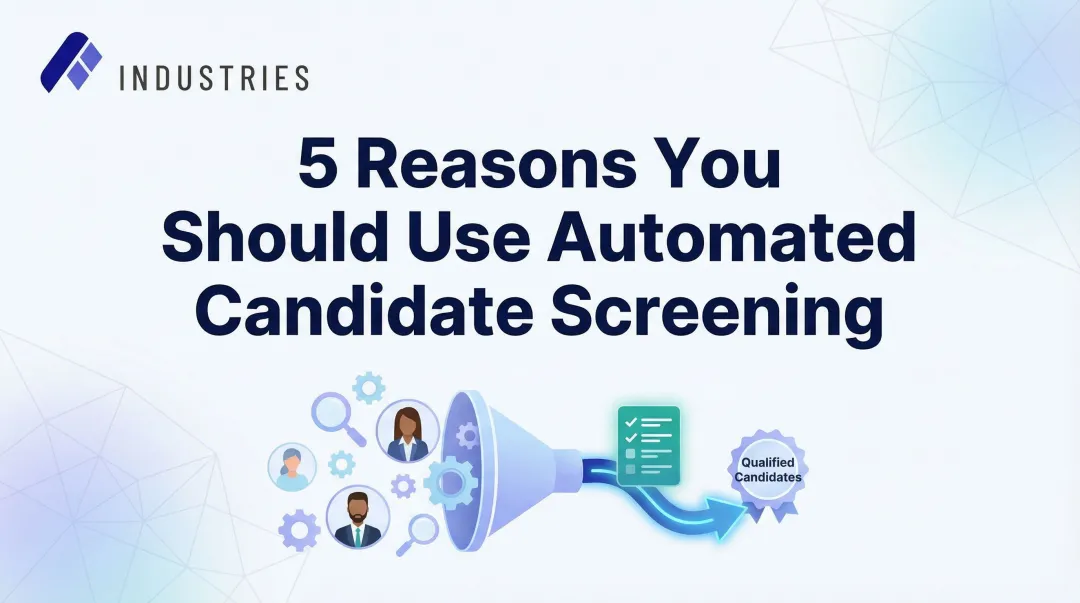
AI resume screening is the automated use of machine learning or rule-based algorithms to parse, evaluate, and rank job applications against a set of criteria. A traditional ATS applies fixed keyword filters; modern AI systems go further, learning and adapting based on patterns in successful hires.
The Four Types of AI Resume Screening
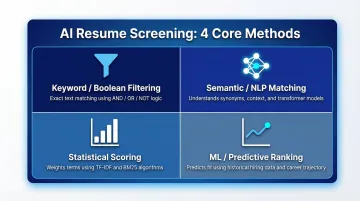
Most enterprise systems combine multiple approaches:
Keyword/Boolean Filtering: Uses exact text-string matching and logical operators (AND, OR, NOT) to filter candidates. If the job description says "project management" but your resume says "program coordination," legacy systems may miss the match entirely.
Semantic/NLP Matching: Uses transformer models like BERT to understand context and synonyms. Modern systems recognize that "client relations" equals "customer success" and that "Django" implies "Python backend development."
Statistical Scoring: Uses algorithms like TF-IDF and BM25 to weight terms based on frequency in your document versus rarity across all resumes. Keywords that appear often in the job description but rarely in most resumes carry higher weight.
ML/Predictive Ranking: Trains on historical hiring data to predict a candidate's likelihood of success, retention, or promotion. These systems evaluate career trajectory, tenure patterns, and company stage—not just keywords.
What AI Screening Is NOT
- Not uniform: Every employer's system is different
- Not infallible: 88% of employers acknowledge that highly skilled candidates are sometimes filtered out simply because their resumes don't match exact terminology
- Not a final decision: It's a volume-reduction tool that creates a shortlist for human recruiters
How AI Resume Screening Actually Works
AI resume screening operates through a defined sequence of stages. Understanding this sequence is the first step to navigating it effectively.
Initiation: Parsing and Ingestion
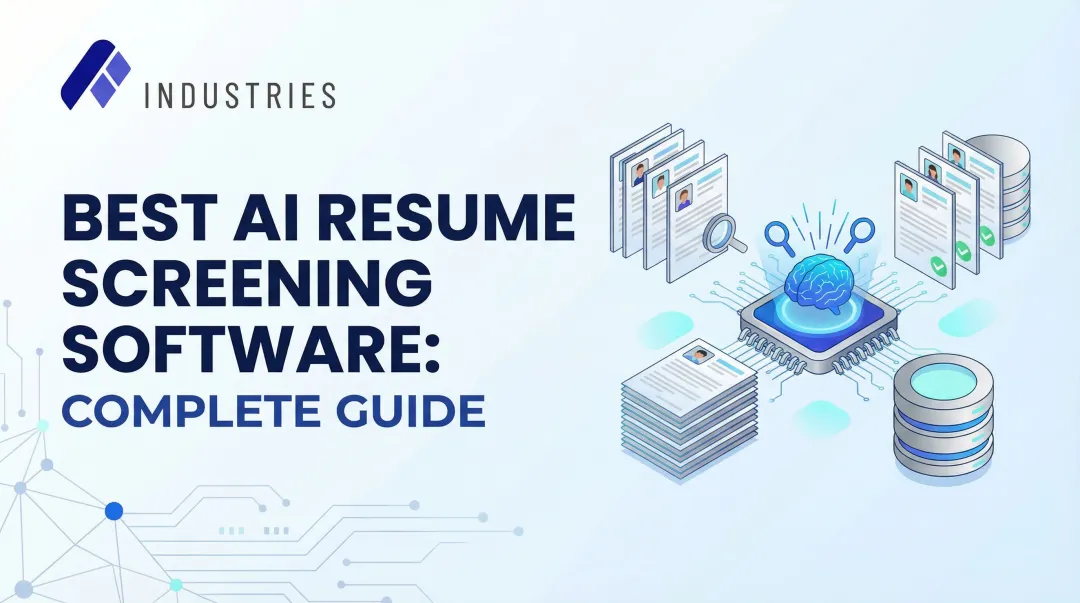
The moment you upload your resume, the system runs it through a parser that breaks the document into structured fields: name, contact info, work history titles, dates, skills, and education. This data is stored for processing.
The parsing stage is where most failures occur. Formatting issues—tables, text boxes, unusual fonts, graphics, or multi-column layouts—cause misreads that corrupt candidate data downstream. If parsing fails, the downstream ranking algorithms produce a score of zero, meaning the AI never "sees" your skills or job titles.
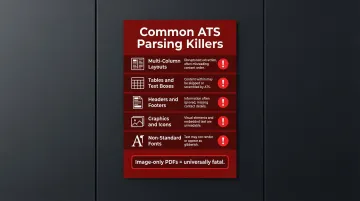
Common parsing killers:
| Problematic Element | What Happens |
|---|---|
| Multi-column layouts | Parser reads straight across, merging "Skills" in the left column with "Experience" in the right into nonsense |
| Tables and text boxes | Disrupts reading order; data hidden inside tables is often skipped entirely |
| Headers and footers | Contact information placed here is frequently ignored |
| Graphics and icons | Cannot be read; skill-rating bars render as garbage characters |
| Non-standard fonts | Custom fonts may render as gibberish during text extraction |
File format matters: Text-based PDFs and DOCX files work for most modern systems, but DOCX remains the native language of parsers. Image-only PDFs (scanned documents) are universally fatal—if you can't highlight the text with a cursor, the ATS can't read it.
Core Operation: Matching and Semantic Analysis
After parsing, the system compares your structured data against the job description. Modern ML-based systems go beyond exact keyword matching to identify semantic equivalents, but keyword proximity and frequency still matter significantly.
High-weight signals:
- Job titles that match the role
- Required skills mentioned explicitly
- Years of experience in relevant areas
- Education credentials
Vague phrasing like "responsible for managing projects" scores lower than specific, outcome-linked language like "led 12-person team delivering $2M project 3 weeks ahead of schedule."
Statistical scoring still dominates most systems. Algorithms like BM25 calculate relevance based on term frequency—how often a keyword appears in your resume—and inverse document frequency, which weights how rare a term is across all resumes. The more times a relevant term appears naturally in context, the higher your score, though saturation limits prevent gains from pure keyword stuffing.
Enterprise-level systems increasingly use agentic AI that evaluates not just what your resume says but what it implies—examining career trajectory, company stage, tenure patterns, and verified contributions rather than text alone.
Scoring and Ranking
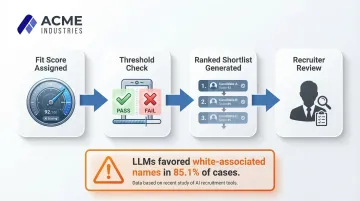
Candidates receive a fit score based on the matching stage, and this score determines shortlist ranking. Scoring thresholds—not just rankings—often determine automatic rejection, meaning a resume below a certain score may never enter human review regardless of context.
One widespread assumption is worth correcting: 92% of recruiters do not use AI match scores for automatic rejection. Automated rejections are almost entirely driven by binary knockout questions built into application forms—"Do you require visa sponsorship?" or "Do you hold a valid RN license?" AI scores prioritize and sort candidates; they don't typically eliminate them outright.
Algorithmic bias is a documented problem in these systems. ML models trained on historical hiring data can absorb past biases and reproduce them at scale. A 2024 study found that LLMs favored white-associated names in 85.1% of cases and male-associated names in 88.9% of cases. Resumes with Black male-associated names were disadvantaged in up to 100% of test cases. If a model was trained on data where previous hires came from certain schools or career patterns, it may penalize candidates who don't match those patterns—regardless of actual qualifications.
Output: Shortlist Delivery
The system produces a ranked shortlist delivered to recruiters, often with a fit score breakdown or explainability summary depending on the platform. This is the first point where a human re-enters the process—and the quality of that shortlist directly shapes how quickly and fairly the next stage proceeds.
Why AI Screening Gets It Wrong: Bias and Blind Spots
The Vocabulary Trap
Qualified candidates who describe the same skills with different vocabulary—especially career changers, non-native English speakers, or professionals from non-traditional backgrounds—can score poorly despite being a strong match. If the job description says "stakeholder management" but your resume says "client relationship coordination," legacy keyword systems may filter you out entirely.
Algorithmic Bias Through Training Data
If an AI model is trained on past successful hires from a homogeneous talent pool, it learns to score similar profiles higher and deprioritize candidates from different educational backgrounds, company sizes, or career paths. Regulators have started responding directly:
Recent regulatory responses:
- NYC Local Law 144 (2023): Prohibits employers from using Automated Employment Decision Tools unless the tool undergoes an independent, third-party bias audit annually, with results published publicly
- EU AI Act (2024): Classifies AI systems used for recruitment and resume sorting as "high-risk," subjecting them to strict requirements for risk mitigation and human oversight
- EEOC Title VII & ADA Guidance (2022-2023): Clarifies that employers are liable for disparate impact discrimination caused by algorithmic tools
AI-Generated Resume Detection
Bias isn't the only blind spot—some screening systems now penalize candidates for how their resume was written, not just what's in it. Some systems flag resumes that appear AI-written or show near-verbatim copying of job description language. In 2025, 62% of employers reported rejecting AI-generated resumes that lacked personalization.
That said, major enterprise ATS platforms don't explicitly advertise native AI-text detection. Vendors focus on AI assistive features instead, leaving recruiters to rely on third-party integrations or manual review to catch generic, keyword-stuffed applications.
Using AI to polish grammar and sharpen clarity is fine. Using it to fabricate content or stuff keywords is what gets resumes rejected—and rightfully so.
How to Beat the Bots: Practical Strategies to Pass AI Screening
Passing AI screening comes down to one thing: presenting your genuine experience in a format the system can actually read. Think of it as translating real qualifications into machine-readable form — nothing fabricated, nothing hidden.
Format for Machine Readability
Use a clean, single-column layout with standard fonts. Avoid headers/footers for critical contact info, tables, text boxes, images, and special characters. Use standard section labels that ATS parsers expect:
- "Work Experience" (not "My Journey")
- "Skills" (not "Core Competencies")
- "Education" (not "Academic Background")
Parsers read top-to-bottom and left-to-right. Complex visual designs break this logic — the system scrambles data or skips sections entirely.
For dates, use MM/YYYY consistently. Vague entries like "Summer 2022" cause parsers to fail silently, blocking the ATS from calculating your years of experience.
Mirror Job Description Language Strategically
Analyze the job posting for recurring keywords and phrases, especially in the requirements section. Incorporate them naturally into your resume.
Industry platforms like Jobscan recommend aiming for an 80% keyword match rate between your resume and the job description. Hitting 75–80% ensures strong visibility without triggering over-optimization flags.
Candidates who stuff keywords or use hacks like "white fonting" — hiding text in white on a white background — are easily detected by modern ATS parsers. It backfires.
To integrate keywords effectively:
- Use 5–7 primary keywords drawn directly from the job description
- Add 3–5 secondary synonyms to capture semantic variation
- Place keywords inside experience bullet points — not dumped into a disconnected list
- Keep the language genuine; every term should describe something you actually did
Quantify Everything Possible
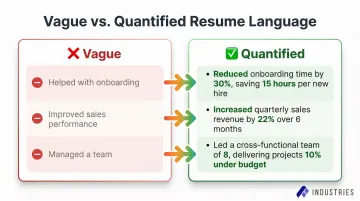
Replace vague claims with specific, data-backed statements. Numbers are high-weight signals for both ML models and human reviewers because they suggest concrete outcomes rather than general responsibilities.
Examples:
❌ "Improved efficiency"
✅ "Reduced onboarding time by 30%, saving 15 hours per new hire"
❌ "Managed social media accounts"
✅ "Grew Instagram following from 5K to 47K in 8 months, driving 23% increase in web traffic"
Build a Dedicated Skills Section
Many AI systems specifically parse and score a standalone skills block. Include both technical and soft skills relevant to the role in bullet format — this gives the parser a clear, structured data field to extract rather than requiring it to infer skills from prose.
List both acronyms and full terms — for example, "AWS" and "Amazon Web Services" — to ensure you're credited by both legacy keyword parsers and modern semantic engines.
Apply Through Direct Company Channels When Possible
Third-party job boards deliver roughly 50% of all applications but generate only 27% of actual hires. Yet candidates applying directly through a company's native career site account for just 1.9% of application volume while producing 3.6% of hires — effectively doubling the conversion rate.
Direct applications signal higher intent and bypass initial filtering algorithms used by third-party aggregators. They also increase visibility within the employer's own ATS.
Use AI Tools to Polish, Not Fabricate
AI writing tools can legitimately help with grammar, clarity, and phrasing consistency. But fabricated experience or AI-generated job descriptions inflate resumes in ways that are increasingly detectable. The goal is presenting real experience clearly, not inventing it.
Where AI Resume Screening Fits in the Hiring Funnel
AI resume screening typically operates at the top of the hiring funnel. Its primary function is volume reduction—taking hundreds or thousands of applications down to a manageable shortlist for human review.
Typical hiring funnel stages:
- Job posting
- Application submission
- AI screening (you are here)
- Recruiter review of shortlist
- Phone screen
- Interview rounds
- Offer
The line between AI screening and the rest of the hiring process is narrowing fast. Some enterprise platforms now use AI across the entire funnel—from job post optimization to candidate ranking to interview scheduling.
For organizations running end-to-end AI workflow integration (versus single-point ATS tools), a candidate's profile and career history get evaluated at multiple stages, not just the resume upload moment.
Assembly Industries, for example, runs resume screening, pre-screening interviews, skills assessments, interview scheduling, and background checks as a single connected workflow rather than isolated steps handed off between teams. That matters for candidates: the "beat the bots" principles apply beyond just the resume. Your entire candidate journey is being evaluated by interconnected AI agents, with human oversight at key decision points.
Frequently Asked Questions
Do employers use AI to screen resumes?
Yes. As of 2025, 97.8% of Fortune 500 companies use an Applicant Tracking System, and 43% of all organizations actively use AI for HR tasks, with resume screening and candidate matching being the primary use cases.
How does AI resume screening work?
A resume is parsed into structured data (name, job titles, skills, dates), compared against the job description using keyword matching or ML models, scored for fit based on relevance and historical patterns, and ranked. Candidates above a scoring threshold advance to human review, while knockout questions (visa status, required licenses) trigger automatic rejections.
Do resume scanners detect AI-generated resumes?
Many modern ATS systems flag AI-generated content through linguistic pattern detection, and verbatim job description copying can trigger duplication filters. No major enterprise platform offers foolproof AI-text detection, but the safest approach is using AI to polish authentic content—not fabricate experience from scratch.
Which AI tools are commonly used for resume screening?
Widely used platforms include iCIMS (Coalesce AI), Workday (Skills Cloud AI), SAP SuccessFactors (Talent Intelligence Hub), Oracle Recruiting Cloud, Greenhouse, and Lever. Specialized vendors like Eightfold AI, HireEZ, and Paradox are often layered on top for semantic matching and conversational screening.
Can I use AI to help write my resume for AI screening?
Yes—AI tools legitimately help with grammar, clarity, and keyword alignment. The goal is representing real experience in a format the system reads well. Fabricated content and keyword stuffing get flagged by detection systems or caught immediately by human reviewers.