Introduction
Enterprise talent teams face an overwhelming challenge: the average corporate role now attracts 257.6 applications, up from 207.2 just a year ago. Manual resume screening consumes 23 hours per hire and pushes time-to-hire to 41-44 days. While teams are still sorting resumes, 57% of candidates abandon applications mid-process and top performers accept competing offers.
AI resume screening software addresses this directly. Earlier platforms relied on keyword matching that rejected 75% of qualified candidates for missing exact phrases. Today's systems use natural language processing and machine learning to analyze career trajectories, infer adjacent skills, and rank candidates by contextual fit—achieving 90-94% matching accuracy while cutting screening time by 70-90%.
This guide evaluates the five best AI resume screening platforms available in 2025, selected based on matching accuracy, enterprise adoption, integration depth, and documented time-to-hire improvements.
Key Takeaways
- AI resume screening uses machine learning and NLP to evaluate, rank, and shortlist candidates—not just keyword matching
- Top 2025 tools: Eightfold.ai (enterprise skills mapping), HireVue (multi-modal assessments), Paradox.ai (high-volume conversational screening), Fetcher (sourcing + screening for lean teams), SeekOut (diversity-focused talent discovery)
- Evaluate based on AI matching accuracy, bias controls, ATS/HRIS integration, scalability, and total cost of ownership
- AI screening cuts first-pass filtering so recruiters spend time on final-round decisions—it augments, not replaces, human judgment
- For end-to-end hiring automation, pair screening tools with orchestration platforms that connect AI outputs to downstream workflows
What Is AI Resume Screening Software?
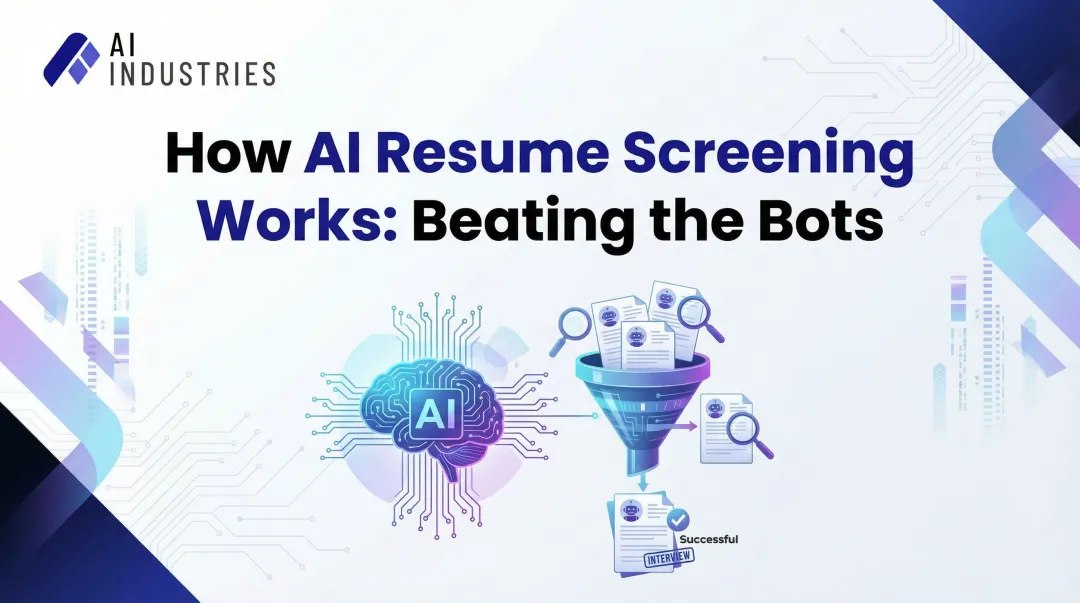
AI resume screening software uses machine learning and natural language processing to parse resumes, extract structured data (skills, experience, education), and match candidates against job requirements—producing ranked shortlists automatically. Unlike traditional ATS platforms that filter resumes via rigid keyword rules, AI systems understand context and synonyms, recognizing that "client relations" and "customer success" describe overlapping capabilities.
Beyond Keywords: What Modern AI Actually Analyzes
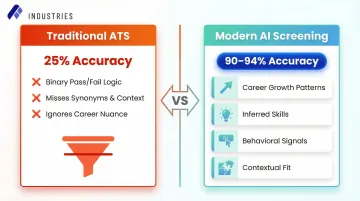
Traditional ATS platforms operate on binary logic: candidates either match exact keywords or they don't. This approach falsely rejects up to 75% of qualified applicants for lacking specific phrases. Modern AI screening systems analyze far richer signals:
- Growth velocity and role progression patterns across a candidate's career history
- Capabilities inferred from past roles, even when specific skills aren't explicitly listed
- Behavioral signals like application completeness and employer brand engagement
- Contextual fit — for example, recognizing that a Python engineer with data pipeline experience is viable for ML roles
Studies from HR technology researchers suggest semantic AI matching can achieve 90–94% accuracy compared to keyword filters — a gap that compounds quickly at high application volumes.
The Market Has Fragmented
That capability gap has driven rapid adoption — AI-assisted screening climbed from 26% of organizations in 2024 to an estimated 43% in 2025 — and the market has responded by splitting into specialized tools. Some platforms excel at high-volume hourly hiring via SMS chatbots. Others focus on skills-based enterprise matching or diversity-driven sourcing.
The section below reviews the five best platforms, evaluated on AI matching depth, automation capability, how well they connect with existing HR tools, bias controls, and proven enterprise adoption.
Best AI Resume Screening Software
These five platforms were evaluated on AI matching depth, automation capability, integration breadth, bias controls, and proven enterprise adoption.
Eightfold.ai
Eightfold.ai is an enterprise talent intelligence platform that uses deep learning to match candidates to roles based on inferred skills and potential, not just listed credentials. The platform has strong adoption among Fortune 500 companies (one-third of its customer base) and supports internal mobility alongside external hiring.
Core differentiators:
- Maps 1.6 million skills across 1.6 billion career profiles, inferring adjacent capabilities and predicting role fit
- Built-in bias masking and diversity analytics promote fair, merit-based screening
- Talent intelligence dashboards surface market insights, skills gaps, and workforce trends — extending its value beyond screening into strategic workforce planning
Proven enterprise impact:
- Amdocs achieved 40% improvement in time to source and 20% improvement in time to hire
- Coca-Cola Europacific Partners increased internal mobility from 38% to 48% and saw a 6-point employee engagement lift
| Key Features | Deep-learning resume matching, skills inference engine, internal mobility module, diversity filtering, talent market analytics |
| Best For | Large enterprises with complex, high-volume hiring needs and a priority on skills-based and diversity-conscious screening |
| Pricing | Custom/enterprise-only (contact for quote) |
HireVue
HireVue combines structured video interviewing with AI-scored assessments to enable multi-dimensional early-stage evaluation before a recruiter invests time in a call. The platform goes beyond resume parsing by layering validated assessments that predict job performance.
Where it excels:
- Resume parsing + structured video scoring + assessment library gives predictive signals about communication, problem-solving, and cultural fit
- Third-party algorithmic audits confirm fairness; uses "multi-penalty optimization" to minimize demographic bias while maintaining predictive validity
- Only FedRAMP-authorized hiring solution for the public sector; aligns with Illinois AI Video Interview Act requirements
- Proprietary NLP model (based on RoBERTa) analyzes candidate responses via speech-to-text — facial analysis was removed in 2020 after NLP alone proved more predictive and less prone to visual bias
| Key Features | AI resume parsing, structured video interview scoring, assessment library, hiring gamification, automated scheduling |
| Best For | Enterprises and mid-market companies that want objective, multi-modal early-stage screening beyond resume review alone |
| Pricing | Custom/enterprise pricing (typically starts around $35,000/year) |
Paradox.ai (Olivia)
Paradox.ai's conversational AI assistant Olivia conducts candidate screening via chat — asking role-specific qualification questions, confirming eligibility, and scheduling interviews in real time via SMS, web, or mobile. The platform dominates high-volume, hourly, and frontline hiring.
How it works:
- Candidates go from application to scheduled interview in minutes without recruiter involvement
- Operates 24/7 across SMS, WhatsApp, and web in 100+ languages
- Real-time calendar syncing with recruiters eliminates back-and-forth coordination
Proven high-volume ROI:
- General Motors saved $2 million in the first year by automating interview scheduling
- Essentia Health increased scheduled interviews by 100% with 24/7 candidate capture
- Checkers & Rally's saved 35,000 hours annually and reduced time-to-hire by 6 days
| Key Features | Conversational AI screening via SMS/web/mobile, automated interview scheduling, multi-language support, ATS integration |
| Best For | High-volume recruiters in retail, logistics, hospitality, and healthcare hiring frontline or hourly workers at speed |
| Pricing | Custom/enterprise pricing based on hiring volume (estimated $30,000–$100,000+/year) |
Fetcher
Fetcher is an AI-powered recruiting platform that combines resume screening with automated candidate sourcing and personalized outreach sequencing. It's a strong fit for smaller or leaner recruiting teams that need to manage the full top-of-funnel in one tool.
What makes it different:
- AI scores incoming applicants while simultaneously building outbound candidate pipelines, reducing the need for multiple point solutions
- Higher tiers include human success teams that verify AI-sourced profiles before delivery
- Tracks email sequence performance, response rates, and interested prospects (averages 40% response rate)
Mid-market success stories:
- Magnite's automated email sequences achieved 90% response rate in head-to-head test against LinkedIn InMail
- Counterpart's one-person People team saved 6-7 hours weekly while achieving 37% response rate and 55% interested rate
| Key Features | AI resume scoring, automated sourcing, personalized outreach sequences, engagement analytics, interview scheduling integrations |
| Best For | Small-to-mid-sized teams that want screening and sourcing automation unified in a single tool without heavy ATS overhead |
| Pricing | Published tiers: Starter ($0 for 50 profiles/month), Growth ($149/user/month), Amplify ($549/user/month with human verification) |
SeekOut
SeekOut is an AI talent search and screening platform that blends inbound resume matching with powerful external sourcing capabilities — particularly strong for hard-to-fill roles and diversity-focused hiring initiatives.
Sourcing and screening depth:
- Combines 800 million to 1 billion candidate profiles from LinkedIn, GitHub, research papers, and patents
- 300+ Power Filters plus a "Bias Reducer" feature that eliminates demographic indicators (names, photos, school names) to prevent unconscious bias
- Daily ATS data mirroring enriches past applicant profiles with updated social links and work history
Technical and niche hiring success:
- Aviatrix scaled from 60 to 220 employees in 18 months, hired 30% from underrepresented groups using diversity filters
- UiPath uncovered highly qualified ML scientists invisible on LinkedIn using publication filters and GitHub "Coder Scores"
| Key Features | AI skills inference, diversity sourcing filters, aggregated candidate profiles, talent market insights, ATS integration |
| Best For | Recruiting teams focused on niche, technical, or underrepresented talent where both inbound screening quality and proactive sourcing depth matter |
| Pricing | Published: SeekOut Recruit starts at $833/month per seat (annual billing) |
How We Chose the Best AI Resume Screening Software
A common buyer mistake: choosing a tool based on brand recognition or feature count alone, without validating whether the AI model actually improves candidate quality or just replicates ATS keyword-matching behavior in a new interface.
Core Evaluation Factors
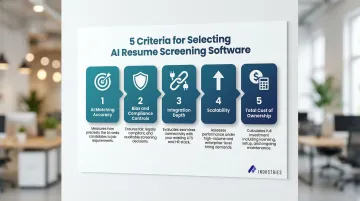
1. AI Matching Accuracy We prioritized platforms using semantic NLP and transformer-based models that infer skills and understand context—not just match keywords. These approaches achieve 90-94% matching accuracy versus roughly 25% for traditional keyword filters.
2. Bias and Compliance Controls We required platforms with independent third-party audits, explainability statements, and adherence to the NIST AI Risk Management Framework. This matters in 2025: NYC Local Law 144, Illinois AI Video Interview Act, and Colorado SB24-205 all mandate annual bias audits, candidate consent, and impact assessments.
3. Integration Depth Clean integration with existing ATS, HRIS, and calendar tools is non-negotiable. We evaluated bi-directional sync, API documentation quality, and verified integrations with Workday, Greenhouse, Lever, iCIMS, and SAP SuccessFactors.
4. Scalability We prioritized platforms with enterprise-grade infrastructure and auto-scaling—verified through documented performance in high-volume hiring environments, not just vendor claims.
5. Total Cost of Ownership Licensing, implementation, and ongoing management costs relative to time-to-hire improvements. Enterprise platforms like Eightfold can take 2-5 months to implement. We factored in change management, training, and recurring compliance costs (e.g., annual bias audits).
Beyond Standalone Screening
Most tools on this list handle screening well. Few handle what comes after.
For enterprises that need to automate the full recruiting workflow—not just the resume filter—Assembly Industries offers an orchestration layer that connects screening outputs to downstream HR processes. That includes candidate engagement, pre-screening interviews in 74+ languages (via Assembly Talk), automated reference and background checks, and conversational onboarding, all connected through 35+ integrations across ATS, HRIS, ERP, VMS, and CRM systems.
Conclusion
The right AI resume screening software depends on your hiring volume, team structure, compliance requirements, and existing tech stack — not which platform has the longest feature list. Here's where each tool fits best:
- Paradox.ai — high-volume hourly hiring via SMS
- Eightfold.ai — enterprise skills-based matching
- HireVue — multi-modal assessment depth
- SeekOut / Fetcher — when sourcing and screening need to work in tandem
Before full deployment, run a structured pilot:
- Test shortlist quality against known successful hires
- Measure recruiter time savings with real workflows
- Validate ATS/HRIS integration in your environment
- Confirm bias audit results and compliance alignment
Enterprises that want to go beyond screening and automate the full recruiting lifecycle — covering sourcing, screening, scheduling, communications, and onboarding — can explore how Assembly Industries orchestrates the entire recruiting workflow from a single platform, with outcome-based contracts and measurable SLAs.
Frequently Asked Questions
Which AI resume screening software is best for reviewing resumes?
There's no universal winner. Eightfold.ai leads for enterprise skills-based matching, HireVue for multi-dimensional assessment depth, and Paradox.ai for high-volume hourly roles. Evaluate based on your hiring volume, team size, compliance needs, and integration requirements.
Can AI resume screening software review and analyze my resume?
These tools are designed for employers, not candidates. They parse and rank resumes based on criteria set by the hiring team. Improve your chances by using ATS-friendly formatting, matching keywords from the job description, and keeping section headers simple and clear.
Is 72 a good ATS score?
ATS scores vary by platform and there is no universal benchmark. On most scoring tools, a score above 70 is considered competitive, but the actual cutoff depends on how the employer configured screening criteria and how many applicants are in the pool. A 72 might be strong in a small pool but marginal when competing against hundreds of candidates.
What is the difference between an ATS and AI resume screening software?
Traditional ATS (Applicant Tracking Systems) store, organize, and filter applications primarily via keyword rules—binary pass/fail logic. AI screening software uses machine learning to infer skills, assess fit contextually, and rank candidates with greater nuance than rule-based filtering, achieving 90-94% accuracy versus keyword matching's 25% success rate.
How does AI resume screening reduce bias in hiring?
AI tools reduce unconscious bias by standardizing criteria and removing demographic identifiers, though poorly trained models can encode historical bias from training data. Choose platforms with built-in fairness auditing, DEI controls, third-party bias audits, and adherence to the Four-Fifths Rule for disparate impact testing.
How much does AI resume screening software typically cost?
Enterprise-grade platforms like Eightfold.ai and HireVue use custom pricing based on hiring volume and seat count (HireVue typically starts around $35,000/year; Paradox.ai ranges $30,000-$100,000+). Mid-market tools like Fetcher offer published subscription tiers starting at $149/user/month. Factor in implementation, integration, training, and ongoing compliance costs (such as annual bias audits) when comparing total cost of ownership.