Introduction
Enterprise talent acquisition teams face mounting pressure. According to SHRM's 2025 Recruiting Benchmarking Report, extra-large organizations (5,000+ employees) now average 61 days to fill non-executive roles—17 days longer than the overall median. Meanwhile, recruiters are managing triple the requisition volume of smaller organizations, and 69% of companies struggle to fill full-time regular positions. The traditional hiring model—manual resume review, endless scheduling emails, disconnected onboarding systems—is breaking under the strain.
Automated staffing represents a fundamental shift from reactive, task-based recruiting to AI-orchestrated, proactive talent acquisition. Instead of digitizing manual steps, it uses machine learning to make intelligent decisions about candidate fit, predictive matching, and workflow coordination across the entire hiring lifecycle.
This guide covers what automated staffing actually means, where the ROI is real, and how to get started without the missteps.
Key Takeaways
- AI-powered staffing reduces time-to-hire by up to 50% by automating screening, scheduling, and onboarding
- Platforms combining AI with expert oversight can cut staffing costs by 60-70% versus traditional models
- AI tools handle 75% of candidate communications and cut resume review time by 62%
- Success requires addressing algorithmic bias, data privacy, and maintaining human oversight
- Start with high-ROI automations like scheduling and screening before tackling complex AI use cases
What Is Automated Staffing?
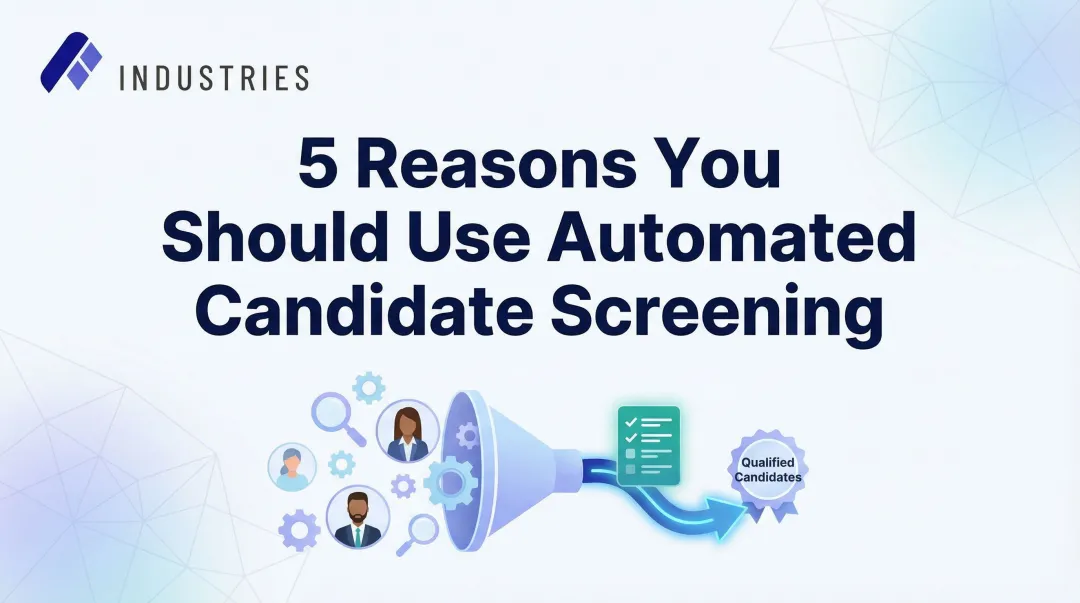
Automated staffing uses artificial intelligence, machine learning, and workflow automation to handle repetitive, time-intensive hiring tasks—sourcing, screening, scheduling, onboarding, and compliance—so human recruiters can focus on strategic relationship building and closing top candidates. Instead of manually reviewing hundreds of resumes or chasing interview schedules across endless email threads, AI agents execute these processes autonomously—flagging exceptions and judgment calls for human review only when needed.
Beyond Basic Automation
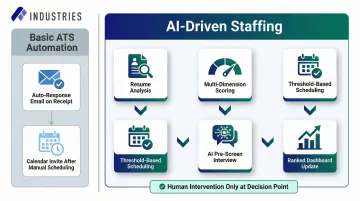
The distinction between basic recruiting automation and true AI-driven staffing matters. Basic automation handles simple triggers. True AI-driven staffing makes decisions. The difference shows up in what each approach can actually do:
- Basic automation: auto-response emails on application, calendar invites after manual scheduling
- Semantic matching: evaluates candidate skills in context, not just keyword overlap
- Predictive scoring: ranks applicants by likelihood of success based on historical patterns
- Behavioral pattern recognition: surfaces top-performer profiles from past hiring data
For example, a basic ATS might send an acknowledgment email when a resume arrives. An AI-powered system analyzes that resume against job requirements, scores the candidate on multiple dimensions, schedules a pre-screening interview if they meet thresholds, conducts that interview via conversational AI, and updates the recruiter's dashboard with ranked recommendations—all without human intervention until a hiring decision is needed.
Modern Automation Personnel Services
"Automation personnel services" refers to staffing functions delivered through a combination of automated technology and human oversight—rather than purely manual agency processes. Traditional temp agencies rely on human recruiters to source, screen, and place every candidate.
Modern automation personnel services flip that model. AI handles high-volume tasks while human specialists manage exceptions, complex assessments, and client relationships.
This hybrid model differs from legacy staffing agencies. Instead of paying for human labor at every step, enterprises access intelligent systems that process thousands of candidates simultaneously, with expert oversight applied only where judgment is required. The result: faster placements, lower costs, higher consistency, and a talent pipeline that scales without adding headcount to the recruiting team.
Where AI Is Actively Transforming Talent Acquisition
Intelligent Candidate Sourcing and Screening
AI-powered sourcing tools scan job boards, internal talent databases, LinkedIn, and professional networks simultaneously to surface qualified candidates far faster than manual searches. Rather than keyword matching that returns hundreds of irrelevant profiles, machine learning models rank candidates based on role fit, skills alignment, experience patterns, and behavioral indicators that predict success.
For high-volume hiring, the numbers tell the story. AI screening tools process hundreds of applications in minutes, and early adopters save 4+ hours per role while reviewing 62% fewer profiles to find qualified matches. When the average corporate job posting receives 257.5 applications and 70% of resumes are rejected at initial screening, automation eliminates the bottleneck that traditionally consumes the majority of recruiter time.
Semantic matching goes beyond surface-level keywords to understand context, transferable skills, and role requirements. An AI system recognizes that a "Customer Success Manager" and "Client Relationship Manager" may have equivalent experience, or that a candidate's project management certification compensates for shorter tenure in a specific industry.
Automated Scheduling and Candidate Communication
Manual interview scheduling consumes 2-3 hours per candidate, creating delays that cost placements. AI scheduling tools integrate with recruiter and hiring manager calendars, match availability automatically, send confirmations, and reschedule when conflicts arise—without a single coordination email.
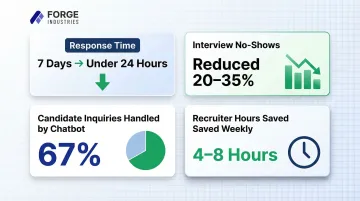
Automated communication sequences keep candidates engaged throughout the process, reducing ghosting and drop-off. Results across early adopters include:
- Candidate response time dropped from 7 days to under 24 hours
- Interview no-show rates reduced by 20-35%
- Chatbots handle 67% of initial candidate inquiries without human involvement
- Recruiters save 4-8 hours per week on repetitive candidate FAQs
When 53% of job seekers report being ghosted by employers, automated follow-up and status updates directly improve candidate experience while preventing drop-off that undermines hiring velocity.
AI-Generated Job Descriptions and Assessments
Generative AI helps recruiters write compelling, bias-reduced job descriptions tailored to specific roles, industries, and company tones in seconds. Rather than copying outdated templates that perpetuate gendered language or unnecessary requirements, AI tools analyze high-performing job posts, remove exclusionary phrasing, and optimize for clarity and inclusivity.
AI-driven skills assessments objectively evaluate candidates before they speak with a recruiter. Structured pre-screening interviews via conversational AI run 24/7 across multiple languages, scoring candidates against defined rubrics and automatically updating the ATS with ranked results.
This consistency matters: every candidate receives the same evaluation criteria, rather than outcomes that shift based on interviewer mood or unconscious bias.
Onboarding and Compliance Automation
Onboarding is paperwork-heavy, error-prone, and time-consuming when handled manually. Automation handles form completion, background checks, compliance document collection, and credential verification—reducing recruiter administrative burden and error rates while ensuring regulatory requirements are met consistently across locations and jurisdictions.
Measured outcomes from automated onboarding include:
- 73% reduction in employee data collection errors
- 50% improvement in new hire time-to-productivity
- 60% reduction in onboarding costs for organizations with structured programs
Compliance tracking shifts from firefighting to prevention. AI systems monitor required credentials per role—OSHA certifications, HIPAA training, professional licenses—with 90/60/30-day expiration alerts and automated renewal conversations that close gaps before they become violations.
The Business Case: Real Benefits for Enterprise Teams
Speed: Dramatic Time-to-Fill Reduction
AI-assisted hiring processes consistently outperform manual workflows in cycle-time compression. Organizations using AI report 31% faster hiring times, creating an average 11-day gap between AI-enabled and non-AI organizations. More comprehensive implementations deliver even greater gains—AI can reduce overall time-to-hire by up to 50%.
This speed advantage compounds across high-volume hiring. When enterprise recruiters manage 60 requisitions annually versus the 20-requisition median, eliminating 11-17 days per hire translates to hundreds of productive days reclaimed across the recruiting team.
Cost: Significant Reduction in Cost-Per-Hire
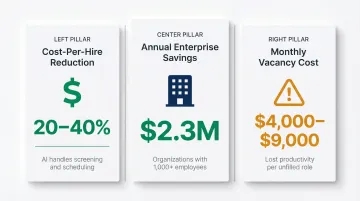
AI automation cuts hiring costs by reducing manual hours, lowering agency reliance, and preventing mis-hires. The financial impact shows up quickly across three dimensions:
- Cost-per-hire drops 20-40% when AI handles screening and scheduling
- Enterprise savings average $2.3 million annually for organizations with 1,000+ employees on comprehensive AI recruitment platforms
- Vacancy costs shrink — SHRM estimates unfilled positions cost $4,000–$9,000 per month in lost productivity and team strain
When AI reduces time-to-fill by 11-25 days, those vacancy savings alone often exceed the reduction in recruiter hours. For enterprises running high-volume hiring year-round, the compounding effect is significant.
Platforms that pair AI with offshore talent delivery go further, cutting total staffing costs by up to 70% compared to traditional US hiring models — primarily by eliminating agency markups that typically run 25-75% above base pay rates.
Quality: Better Candidate-to-Role Fit
Efficiency gains don't come at the expense of quality. Companies using AI-assisted recruiter messaging are 9% more likely to make a quality hire. A 2025 field study covering approximately 70,000 interviews found that AI-led initial screening delivered 12% more job offers and 17% higher 30-day retention rates compared to human-only screening.
AI matching based on skills, behavioral data, and historical performance indicators leads to better candidate-to-role fit and lower early turnover—a significant value driver for enterprise HR teams where mis-hires cost 30-50% of annual salary in replacement and lost productivity.
Productivity: Recruiter Time Reclamation
Recruiters currently spend almost 2 hours per day on administrative tasks like scheduling and data entry. AI automation shifts this balance dramatically. Recruiters using AI tools save approximately 20% of their workweek—effectively gaining back a full day to focus on strategic talent advising, passive candidate relationship building, and closing high-value targets.
When recruiters manage 56% more open requisitions and 2.7x more applications than three years ago, automation becomes the only realistic way to sustain throughput without burning out the team.
Scalability: Rapid Hiring Flex Without Headcount Growth
Automated staffing allows enterprises to scale hiring up or down rapidly in response to demand without proportionally increasing recruiting team headcount. This matters most for businesses with seasonal peaks, project-based workforce needs, or sudden growth phases.
AI systems handle volume surges by automatically scaling to match demand. A recruiting team that manually processed 500 applications per month can handle 2,000 with the same headcount when AI manages initial screening, scheduling, and candidate communications. Human recruiters focus exclusively on qualified candidates and hiring manager relationships — the work that actually requires judgment.
Key Challenges and Ethical Considerations
Algorithmic Bias: The Risk of Scaling Historical Discrimination
AI trained on historical hiring data can inadvertently replicate past biases at scale. The most documented example is Amazon's scrapped 2018 recruiting tool, which taught itself to penalize resumes containing the word "women's" because it learned from a decade of male-dominated tech hiring data. A 2023 National Bureau of Economic Research study found that AI screening tools gave 14% fewer positive callback recommendations to candidates with Black-sounding names compared to white-sounding names with identical credentials.
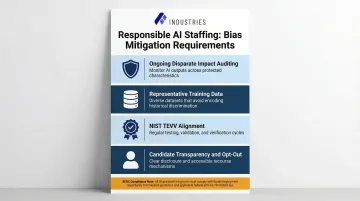
Responsible automated staffing requires:
- Ongoing auditing of AI outputs for disparate impact across protected characteristics
- Diverse, representative training data that doesn't encode historical discrimination
- Regular testing, validation, and verification aligned with the NIST AI Risk Management Framework (TEVV)
- Transparency about how AI is used and clear candidate opt-out mechanisms
The EEOC explicitly warns that AI tools can violate federal law if they create unjustifiable disparate impact, making compliance a legal imperative, not just an ethical consideration.
Data Privacy and Compliance Risks
Automated staffing involves collecting and processing large volumes of sensitive candidate data—resumes, assessment results, interview recordings, background checks, and personal identifiers. This requires robust security infrastructure, GDPR/CCPA compliance, and clear data retention policies.
Candidate trust is fragile: 66% of U.S. adults state they would avoid applying for jobs that use AI to make final hiring decisions, fearing algorithmic bias and lack of transparency. The FTC, EEOC, and DOJ have issued a joint statement pledging to enforce civil rights and consumer protection laws against biased or opaque automated systems.
SOC 2-certified platforms address these concerns through controls such as:
- Encryption (TLS 1.2+ in transit, AES-256 at rest)
- Role-based access controls and multi-factor authentication
- Regular penetration testing and comprehensive audit logging
Enterprises must also verify that vendors provide transparent data handling practices, candidate rights to access and deletion, and compliance with international transfer requirements like EU Standard Contractual Clauses.
The Critical Importance of Human Oversight
Privacy and compliance controls reduce legal exposure—but they don't address accountability for the decisions themselves. AI should augment hiring decisions, not make them autonomously. Final decisions on placement, offers, and sensitive rejections must always involve human reviewers, both ethically and legally. That human oversight layer ensures:
- Complex judgment calls receive appropriate context and empathy
- Edge cases and exceptions are handled fairly
- Candidates have recourse to appeal or clarify AI assessments
- Organizations maintain accountability for hiring outcomes
The most effective implementations position AI as a decision-support tool that handles volume and surfaces insights, while humans retain authority over consequential choices.
From Point Solutions to Full Process Orchestration
The Fragmentation Problem
Most enterprises rely on a patchwork of point solutions—one tool for the ATS, another for scheduling, another for sourcing, another for assessments. The result is three compounding problems:
- Data silos: candidate information doesn't flow between systems
- Workflow gaps: manual handoffs introduce delays and errors
- Inconsistent candidate experiences that erode employer brand
When a recruiter manually copies candidate data into the ATS, schedules interviews in a separate calendar tool, tracks background checks in a spreadsheet, and onboards through yet another system, integration overhead quietly erases the value automation was supposed to deliver.
Unified Orchestration: End-to-End Workflow Coordination
A unified orchestration approach connects sourcing, screening, scheduling, assessment, background checks, and onboarding into a single coordinated workflow with real-time visibility and performance monitoring at every stage. Orchestration platforms go beyond bolt-on tools by providing:
- Single source of truth for candidate data across the entire hiring lifecycle
- Automated handoffs between workflow stages without manual intervention
- Consistent candidate communication regardless of which stage they're in
- Unified analytics that measure performance across the entire process, not just individual tools
This contrasts sharply with point solutions that optimize individual steps while leaving the overall process fragmented and inefficient.
Assembly Industries' Outcome-Accountable Model
Assembly Industries takes orchestration further by combining AI agents with expert-vetted offshore talent and secure automation infrastructure—delivering not just tooling but accountable business outcomes with outcome-based SLAs. This is particularly relevant for enterprise teams that need consistent, high-quality execution without managing multiple vendors.
Instead of software handed off for self-implementation, Assembly's expert services teams encode your scoring rubrics, compliance requirements, and ATS data model directly into the platform. The full recruiting workflow runs as one coordinated process:
- Resume screening and pre-screening interviews (74+ languages)
- Candidate pool management and reference checks
- Background verification and conversational onboarding
Why Outcome Accountability Matters
Technology implementation alone rarely delivers transformation. Enterprises need partners accountable for results, not just handing over software. This shifts the conversation from "we gave you software" to "we delivered X% improvement in time-to-fill and cost-per-hire."
Outcome-based contracts with defined SLAs ensure vendors share responsibility for business results. When a platform provider guarantees specific reductions in time-to-hire or improvements in quality-of-hire, they're incentivized to optimize the entire workflow, not just sell licenses and walk away.
How to Get Started with Automated Staffing
Start with Diagnostic, Not Tools
Before selecting any automation platform, map your current hiring workflow end-to-end. Identify the highest-friction points: Where do candidates drop off? Which stages take longest? Where do errors occur most frequently? Which manual tasks consume the most recruiter time?
Prioritize automation where time loss is greatest and errors carry the highest cost. For most enterprises, this means:
- Resume screening for high-volume roles where hundreds of applications create bottlenecks
- Interview scheduling where coordination delays add days to every hire
- Onboarding compliance where manual document collection creates errors and risk
Begin with High-ROI, Low-Disruption Automations
The best entry points deliver fast wins, carry low implementation risk, and demonstrate ROI to stakeholders before tackling more complex AI use cases:
- Interview scheduling integrates with existing calendars and ATS, saves 2-3 hours per candidate, and requires minimal process change
- Candidate communication sequences reduce ghosting and keep applicants engaged with nothing more than email templates and basic workflow configuration
- Onboarding document automation handles e-signatures, form completion, and compliance collection — clear ROI without sophisticated AI models
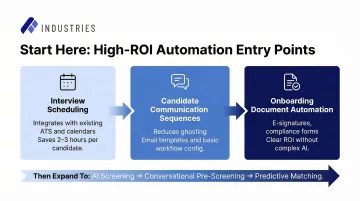
Once these foundational automations prove value, expand to more complex use cases like AI-powered resume screening, conversational pre-screening interviews, and predictive candidate matching. That's when measurement becomes non-negotiable.
Measure Outcomes from Day One
Define KPIs before launch:
- Time-to-fill (days from requisition to offer acceptance)
- Cost-per-hire (total recruiting costs divided by hires)
- Candidate drop-off rate (percentage who disengage at each stage)
- Recruiter hours saved (administrative time reclaimed per week)
- Quality-of-hire (90-day retention, hiring manager satisfaction, performance ratings)
Establish baseline measurements before automation so you can quantify improvement. Build a review cadence—monthly for the first quarter, then quarterly—to evaluate whether automation is delivering against benchmarks and adjust accordingly.
Skipping this step turns automation into an expense you can't justify — and a program you can't improve.
Frequently Asked Questions
What is automation personnel services?
Automation personnel services refers to staffing and recruitment functions delivered through a combination of automated technology—AI screening, scheduling, onboarding tools—and human oversight, rather than purely manual agency processes. The result is faster, more consistent hiring at lower cost than traditional agency models.
What software do staffing agencies use?
Most staffing agencies rely on an ATS for candidate pipelines, CRM tools for relationship management, scheduling automation, onboarding platforms, and AI-powered sourcing tools. The specific mix depends on agency size, industry focus, and integration requirements.
What is an ATS vs CRM?
An ATS manages the active hiring workflow—requisitions, resume collection, screening, scheduling, and offers. A CRM manages ongoing relationships with talent pools and client organizations. Many modern platforms combine both into a single talent acquisition suite.
What ATS is most commonly used?
Leading enterprise ATS platforms include Greenhouse (#1 on G2's Enterprise Grid, Winter 2026), iCIMS (11% global market share), Oracle, SAP SuccessFactors, and Workday—all named Leaders in Gartner's 2025 Magic Quadrant for Talent Acquisition Suites. Selection depends on company size, industry, and whether you need a specialized TA platform or a broader HCM suite.
Is it worth it to go through a staffing agency?
For enterprises with high hiring volume or specialized roles, an AI-augmented staffing agency delivers faster time-to-fill, lower administrative burden, and access to pre-vetted talent pools that would cost significant internal resources to build. Whether it's worth it comes down to whether the agency's markup (typically 25–75% above worker pay) is offset by speed, quality, and what you save on internal recruiting overhead.
How much does a temp agency charge per hour?
Traditional temp agency markups typically range from 25% to 75% above the worker's base pay rate, depending on industry and role complexity. For highly specialized or high-risk roles (healthcare, IT), markups can reach 40-100%. Direct hire placement fees typically cost 18-25% of the candidate's first-year annual salary. AI-augmented staffing models can deliver cost reductions by reducing overhead and manual coordination, often bringing total costs 60-70% below traditional US hiring models.
Automated staffing frees recruiters from administrative work so they can focus on what matters: building relationships, exercising judgment, and closing top talent. The enterprises that win are those that combine AI and human expertise in a system held accountable for business outcomes—not just technology deployment.