Introduction
Most HR teams still struggle with the same bottlenecks: slow hiring cycles, administrative overload, and point solutions that don't talk to each other. The difference in 2026 is that the tools to solve all three now exist—and they're being adopted fast. 82% of CHROs plan to deploy AI agents by May 2026, driven by mounting cost pressures and the growing maturity of enterprise-grade AI systems.
Organizations that have already made the shift are compressing hiring cycles by 23%, cutting HR administrative costs by 60%, and moving their teams off repetitive work entirely. This article breaks down which automation trends are accelerating, what's driving them, and how to position your HR function to benefit.
Key Takeaways
- AI agents in 2026 reason across context and execute multi-step HR workflows autonomously, not just trigger rules
- The highest ROI opportunities are in recruiting, onboarding, employee self-service, compliance, and workforce analytics
- Rising labor costs, talent scarcity, and enterprise-grade LLMs trained on HR contexts are accelerating adoption
- Human oversight paired with AI agents delivers both speed and accountability — the combination outperforms either alone
- Early movers are cutting administrative costs by 60% while compressing HR cycle times by nearly half
The 5 AI-Driven HR Automation Trends Defining 2026
These trends represent a meaningful evolution from automating isolated tasks to orchestrating entire people processes. Each is independently valuable, but together they create compounding efficiency gains that transform how HR teams operate.
AI Agents Replacing Rule-Based Workflow Automation
Traditional HR automation followed fixed if-then logic: if an offer is accepted, trigger an onboarding checklist. In 2026, AI agents can interpret context, handle exceptions, and execute multi-step decisions that previously required human judgment.
Consider a leave request. Legacy automation routes it to a manager for approval. An AI agent reviews the request, checks policy, cross-references team capacity and project deadlines, and routes for approval only when an edge case arises—without a human touching the process until judgment is actually needed.
Orchestration platforms that layer AI agents over existing HR tools (rather than replacing them) are widening their lead over point solutions. The gap between "automation tools" and "outcome-focused orchestration" keeps growing—and the organizations winning are those pairing AI capability with implementation expertise and ongoing management, not just buying software.
Gartner predicts 40% of enterprise applications will feature task-specific AI agents by 2026, up from less than 5% in 2025. The adoption risk is real: over 40% of agentic AI projects will be canceled by end of 2027 due to unclear business value or inadequate risk controls.
Intelligent Recruitment Automation: From Sourcing to Offer
AI agents now handle the full recruiting funnel—sourcing candidates, screening resumes against nuanced role criteria, auto-scheduling interviews, capturing structured interview notes, and flagging quality signals. Recruiter time on coordination drops sharply as a result.
Speed is the obvious win, but candidate quality is where the real gains show up. AI-sourced shortlists using semantic matching produce better candidate fit than keyword-based ATS filtering. A 2025 randomized trial of 70,000 applicants found that AI-led interviews yielded 12% more job offers and 17% higher 30-day retention compared to human-conducted interviews. The reason: AI agents achieve "controlled variance"—making interviews more structured and consistent while remaining responsive, extracting more hiring-relevant information than unstructured human conversations vulnerable to affinity bias.
The operational numbers tell the rest of the story:
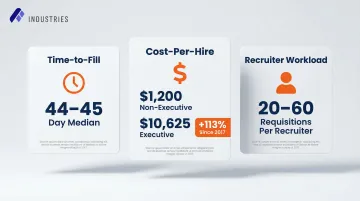
- Time-to-fill benchmarks: Median time-to-fill stands at 44-45 days, with executive roles taking longer and costing dramatically more
- Cost-per-hire: Median cost for nonexecutive roles is $1,200, but executive cost-per-hire has spiked 113% since 2017 to $10,625 median ($35,879 average)
- Recruiter workload: Organizations report a median of 20 requisitions per recruiter annually, scaling to 60 at extra-large organizations
89% of HR professionals using AI in recruiting report it saves time and increases efficiency. The best implementations automate the entire recruiting workflow—from sourcing to offer—while maintaining human oversight for final decisions and candidate relationship management.
Conversational AI and Employee Self-Service
LLM-powered HR chatbots and virtual agents have matured significantly. Employees in 2026 ask natural language questions about benefits, PTO balances, payroll, or policies and receive accurate, personalized responses without waiting on HR staff.
Enterprise deployments have achieved up to 73% ticket deflection, with employee Net Promoter Scores jumping from 30 to 70 following implementation. Johnson Controls cut HR call volume by 30-40% after deploying an agentic AI assistant for over 100,000 global employees to handle routine inquiries about onboarding, policy, and payroll.
Self-service resolution of the most common HR inquiries frees HR teams for complex cases requiring judgment and relationship work. The best implementations connect conversational AI to backend systems so the agent doesn't just answer questions—it acts.
Employees can submit PTO requests, update direct deposit accounts, or enroll in benefits within the conversation, eliminating the need to navigate multiple systems or wait for HR processing.
Key capabilities driving adoption:
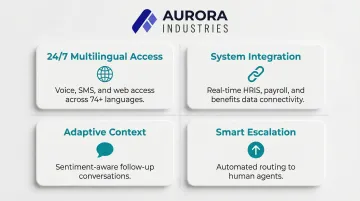
- 24/7 availability across 74+ languages via voice, SMS, and web
- Integration with HRIS, payroll, and benefits systems for real-time data access
- Adaptive follow-ups based on employee sentiment and context
- Automated escalation to human agents for complex or sensitive issues
Predictive HR Analytics and AI-Driven Workforce Planning
AI is shifting HR analytics from descriptive (what happened) to predictive (what will happen)—enabling HR leaders to forecast attrition risk, identify skill gaps before they become critical, and model workforce scenarios tied to business growth plans.
Modern platforms unify data across recruitment, performance, engagement, and compensation to generate proactive recommendations. For example, flagging that a high performer is at attrition risk before they give notice, or identifying that a critical skill gap will emerge in six months based on project pipeline and current team capabilities.
Most organizations aren't using this capability yet. While 73% conduct operational workforce planning, only 12% of US HR leaders engage in strategic workforce planning with a three-to-five-year horizon. Organizations that close this gap gain measurable competitive advantage through better talent deployment and lower attrition costs.
The business case is compelling. The root causes of productivity loss—skill gaps, lack of engagement, and poor time prioritization—cost a median-size S&P 500 company roughly $480 million annually. Predictive analytics that surfaces these issues before they compound enables proactive intervention rather than expensive remediation.
Automated Payroll, Benefits, and Compliance Management
Payroll and compliance automation has moved beyond scheduled batch processing. AI agents now monitor regulatory changes, validate payroll inputs in real time, flag anomalies before processing runs, and auto-update benefits calculations when employee status changes.
As regulatory environments grow more complex—multi-state payroll, benefits parity laws, evolving labor classifications—AI agents that continuously monitor and apply rule changes significantly reduce compliance risk compared to manual processes.
1 in 5 payrolls in the United States contains errors, with the average organization making 15 corrections per payroll period. Each error costs an average of $291 to fix. High-frequency errors like missing time punches drive the highest aggregate costs, while onboarding-related errors (W-4s, visa status) carry the highest per-incident penalties.
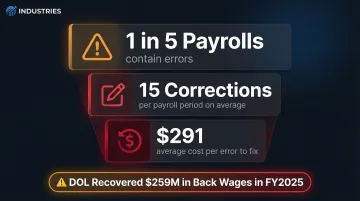
Compliance violations carry equally significant exposure. In Fiscal Year 2025, the DOL Wage and Hour Division recovered $259 million in back wages and assessed $58.7 million in civil penalties.
Automated systems with proper compliance architecture reduce this risk by eliminating inconsistent human handling and maintaining clean, time-stamped audit trails.
What's Driving the AI Agent Revolution in HR
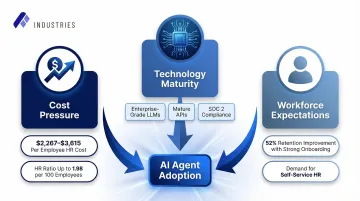
Several forces are converging in 2026 to make AI agent adoption in HR not just viable but competitively necessary. The pressures are economic, technological, and cultural—and they're compounding fast.
Cost and talent pressures: The median HR cost has reached $2,267 per employee, rising to $3,615 per employee in the upper quartile. Simultaneously, the median HR-to-employee ratio has climbed to 1.98 per 100 employees in 2025, up significantly from 1.11 in 2022. Companies cannot continue absorbing these costs with headcount alone—the economics demand automation.
Talent acquisition adds further pressure. Median cost-per-hire sits at $1,200 for nonexecutive roles and tops $10,625 for executive searches — organizations need automation that cuts both time-to-hire and cost-per-hire at once.
Technology maturity: LLMs have reached enterprise-grade reliability for HR contexts. Integration layers (APIs, middleware) have matured, and SOC 2-compliant AI infrastructure has removed the security blockers that slowed adoption in earlier years.
Workforce expectations: Employees expect consumer-grade digital experiences from HR—instant answers, self-service access, and proactive communication. Research shows that a strong onboarding experience can improve employee retention by 52% and productivity by 60%. The gap between what employees expect and what HR can deliver is now a retention risk.
How These Trends Are Impacting the HR Industry
These automation trends are creating measurable impacts across three dimensions: how HR teams operate, how the business perceives HR's value, and how the workforce experiences people processes.
Operational Impact
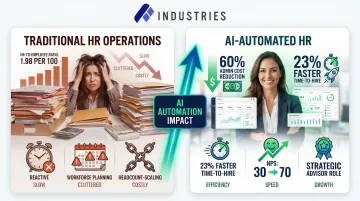
AI-automated HR workflows are compressing cycle times dramatically. AI-driven core processes are reducing time-to-hire by about 23%, while onboarding satisfaction increases by approximately 24%. Hiring cycles, onboarding timelines, and performance review turnarounds are all shrinking.
Error rates in payroll and benefits administration are declining as manual data entry is eliminated. Automated systems improve compliance audit readiness by maintaining clean, time-stamped records that demonstrate policy adherence and provide complete audit trails.
Business Impact
HR is increasingly being measured against business outcomes—quality of hire, retention rates, time-to-productivity—rather than just operational metrics. Automation makes this shift possible by generating the clean, consistent data that links HR activity to business results.
Cost reduction follows. Organizations using AI-first HR automation routinely expand their employee base without adding proportional HR headcount. The median HR-to-employee ratio increased to 1.98 per 100 employees—reflecting a growing administrative burden—but organizations using AI agents are reversing that trend by automating high-volume, repetitive work.
Workforce Impact
HR professionals are shifting from administrative processors to strategic advisors. That transition requires upskilling in data interpretation, process design, and AI oversight—the human role is now about judgment, exception handling, and relationship work.
Employee experience is improving: faster responses, more consistent policy application, and proactive support (such as AI proactively reminding employees about open enrollment) are increasing HR satisfaction scores. The 73% ticket deflection rates and NPS improvements from 30 to 70 demonstrate that employees prefer self-service AI for routine inquiries, freeing HR teams to focus on complex, high-touch interactions.
Future Signals for HR Automation Beyond 2026
The trends above are well underway, but several emerging developments signal where HR automation is heading in the 1-3 year horizon. Early awareness gives HR leaders time to build the right infrastructure now.
Multi-Agent HR Orchestration
The next frontier is coordinated networks of specialized AI agents operating under a single orchestration layer — sourcing, compliance monitoring, and employee inquiries each handled by a dedicated agent working in concert. This eliminates the coordination overhead that plagues multi-tool HR stacks today, where each point solution requires separate configuration, data mapping, and integration maintenance.
Hyper-Personalized Employee Lifecycle Management
AI systems will deliver differentiated experiences based on individual employee profiles — customized onboarding paths, role-specific learning recommendations, proactive career nudges — rather than forcing everyone through the same standardized process. AI agents adapt workflows to individual needs and career trajectories, making personalization practical at enterprise scale.
Regulatory AI in HR
As governments regulate AI use in hiring and employment decisions, compliance capability is becoming a competitive differentiator in its own right.
The EU AI Act classifies AI systems used in employment as "high-risk," with rules entering application on August 2, 2026, requiring fundamental rights impact assessments, human oversight, and registration in an EU database. NYC Local Law 144 actively fines non-compliant employers $500 to $1,500 per day for using automated employment decision tools without annual bias audits and candidate notice.
Two practical implications for HR leaders:
- Auditable workflows become mandatory — not just good practice — for organizations operating under these frameworks
- Opaque, black-box automation systems create escalating legal exposure as enforcement ramps up through 2026 and beyond
Conclusion
AI agents have shifted HR automation from task execution to intelligent end-to-end management of entire people functions — work that previously required dedicated HR ops headcount. The difference isn't incremental. It's a fundamental change in what a lean HR team can actually own and deliver.
The organizations pulling ahead in 2026 share a common approach:
- Move beyond point solutions to unified workflow orchestration
- Combine AI agents with human oversight (not one or the other)
- Hold their automation infrastructure accountable to business outcomes, not just uptime
Waiting has a real cost — in hiring overhead, process inconsistency, and competitive positioning. The organizations that act now are setting a performance baseline that becomes increasingly difficult for slower movers to close.
Frequently Asked Questions
In what ways can artificial intelligence be used in HR — automating routine tasks, conducting job interviews, calculating payroll, monitoring employee attendance?
AI applications span the entire HR lifecycle: screening and interviewing candidates with structured assessments, processing payroll and flagging anomalies before they become costly errors, automating PTO and attendance tracking with real-time validation, and handling employee inquiries through conversational agents. The critical distinction is that AI agents can now manage these end-to-end rather than just assisting with individual steps.
What are the 4 pillars of automation?
The four pillars are: process discovery and design, technology and tooling, governance and compliance, and continuous improvement. In HR automation, governance and compliance carry extra weight given the sensitivity of employee data and growing regulatory scrutiny of AI in employment decisions.
What are the 4 types of HR analytics?
The four types are descriptive (what happened), diagnostic (why it happened), predictive (what will happen), and prescriptive (what should be done). AI is pushing HR teams past the first two into predictive and prescriptive territory, enabling proactive workforce management instead of reactive problem-solving.
What is the difference between HR workflow automation and AI agents in HR?
Workflow automation follows fixed, pre-programmed rules for predictable tasks—if condition X occurs, execute action Y. AI agents can reason across context, handle exceptions, and execute multi-step decisions autonomously based on understanding the situation rather than following rigid logic. This makes agents far more capable for complex or variable HR processes like candidate evaluation, employee sentiment analysis, or compliance monitoring where judgment and adaptation are required.
Which HR processes should be automated first in 2026?
Start with high-volume, repetitive processes: recruiting coordination, onboarding task management, PTO and leave tracking, and employee self-service inquiries. These deliver the fastest ROI and generate the clean data needed for more advanced automation — predictive analytics and workforce planning — down the road.
How do you ensure data security and compliance when automating HR processes?
Prioritize vendors with SOC 2 certification, role-based access controls, and comprehensive audit logging. As frameworks like the EU AI Act and NYC Local Law 144 take effect, auditable AI workflows with human oversight at escalation points are becoming a compliance requirement, not just a best practice.