Introduction
Picture a mid-sized enterprise where the operations team processes 300 vendor invoices weekly, manages 50 new customer onboarding workflows monthly, and coordinates insurance prior authorizations for a busy medical practice—all while skilled employees spend 25+ hours per week on manual data entry, approval routing, and follow-up emails. Despite investing in multiple automation tools, the team still drowns in exceptions, UI breakages, and endless maintenance cycles.
Traditional automation tools promised relief but delivered fragmentation. Rule-based RPA breaks when a vendor updates their portal. Workflow scripts require constant IT intervention. Offshore teams lack context for judgment calls. The result: industry analyses consistently find that organizations spend 70–75% of automation budgets on maintenance rather than innovation.
AI agents solve what rule-based automation cannot. They perceive context, reason through problems, and execute multi-step actions autonomously across systems. They handle ambiguity, learn from outcomes, and adapt to exceptions — making them the core infrastructure of modern enterprise operations.
This article explores what AI agents actually are, how the seven distinct types differ, how they compare to conventional automation, and how enterprises are deploying them to drive measurable outcomes in finance, healthcare, sales, and operations.
Key Takeaways
- AI agents perceive, reason, and act autonomously—driven by goals, not predefined rules
- Seven agent types exist, each suited to different workflow complexities
- Unlike brittle rule-based tools, agents handle ambiguity and adapt continuously
- Finance, healthcare, and sales operations report 40-77% efficiency gains
- Enterprises capture the most value by orchestrating agents end-to-end—not deploying them as disconnected point solutions
What Are AI Agents, Really?
An AI agent is an intelligent system that perceives its environment, reasons through available information, and takes action—often across multiple steps and tools—without waiting for a human to prompt each decision. The underlying model (typically a large language model) handles judgment; the agent handles execution.
The Four Core Components
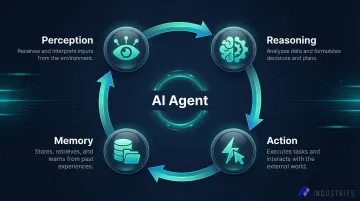
Every enterprise AI agent operates through four foundational capabilities:
- Perception — Gathers information from its environment: reading emails, querying APIs, analyzing documents, monitoring system events. This layer determines what data the agent can access and act on.
- Reasoning — Evaluates options, draws conclusions, and plans sequences of actions using the underlying AI model. Think of it as the decision engine that turns raw inputs into a plan.
- Action — Executes tasks based on those decisions: updating a CRM record, sending a message, triggering a workflow, calling an external API. This is where reasoning becomes a business outcome.
- Memory — Maintains short-term context (the current task) and retrieves long-term knowledge (past interactions, learned patterns, organizational policies), allowing agents to apply accumulated experience over time.
Beyond Chatbots and Copilots
Chatbots answer questions. Copilots assist with single tasks. AI agents do something fundamentally different: they pursue objectives end-to-end, across multiple systems, without waiting for a human to connect the dots.
A customer service agent, for example, doesn't just answer a question — it retrieves account data, drafts a response, logs the interaction, and escalates based on predefined thresholds, all in one uninterrupted sequence. When an API call fails, it retries with different parameters; when data is missing, it queries alternative sources. That combination of goal-oriented autonomy, multi-step orchestration, and proactive adaptation is what separates agents from every automation tool that came before.
Agentic Workflows in Practice
Those capabilities show up clearly in practice. Take invoice processing: an agent receives the invoice via email, extracts line items using OCR, matches them against purchase orders in the ERP, flags discrepancies for human review, routes approvals based on amount thresholds, and updates accounting records — all without a human shepherding each handoff.
Traditional automation handles the same steps only if every input is perfectly predictable. Change a vendor's invoice format, and the pipeline breaks. An agent adapts on the fly, which is the practical difference that matters at scale.
The 7 Types of AI Agents (and What They Do Best)
From Simple to Sophisticated: The Agent Spectrum
Not all AI agents are built the same. Different architectures suit different levels of task complexity, and enterprise deployments often combine multiple types.
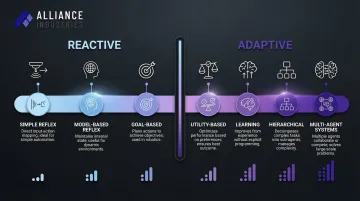
The seven core agent types break down into two groups: reactive agents that respond to conditions, and adaptive agents that learn, plan, or coordinate over time.
Reactive agents handle well-defined, high-volume tasks:
- Simple Reflex — operate on condition-action rules with no memory. Best for routing support tickets by keyword or firing alerts when inventory thresholds are breached. They cannot handle exceptions or ambiguity.
- Model-Based Reflex — maintain an internal state model and adjust decisions as conditions shift. Suited for inventory monitoring that accounts for changing stock levels and supplier lead times.
- Goal-Based — evaluate multiple possible actions and select the path most likely to hit a defined objective. Strong fit for workload scheduling across teams with competing deadlines and capacity constraints.
Adaptive agents handle complexity, trade-offs, and change:
- Utility-Based — weigh competing variables to maximize a utility function. Use cases include dynamic pricing and resource allocation where the agent must balance speed, cost, and quality simultaneously.
- Learning — improve continuously from experience. Accuracy builds over time, making them well suited for fraud detection, churn prediction, or any domain where patterns evolve. A learning agent identifying at-risk accounts gets sharper with every example it processes.
- Hierarchical — operate in a tiered structure where a top-level agent delegates to specialized sub-agents and aggregates results upward. Built for enterprise-scale workflows like order-to-cash or revenue cycle automation.
- Multi-Agent Systems — networks of specialized agents that collaborate and coordinate, each managing one slice of a larger workflow. Best for cross-functional processes like supply chain coordination or full-cycle recruiting, where no single agent can manage the full scope.
Mapping Agent Types to Enterprise Use Cases
The table below maps each type to its highest-value enterprise context at a glance:
| Agent Type | Best For | Example |
|---|---|---|
| Simple Reflex | High-volume routing | Ticket assignment by keyword |
| Model-Based Reflex | Dynamic monitoring | Inventory tracking with supplier variability |
| Goal-Based | Planning & scheduling | Workload optimization across teams |
| Utility-Based | Trade-off optimization | Dynamic pricing or resource allocation |
| Learning | Pattern recognition | Fraud detection, customer churn prediction |
| Hierarchical | Multi-department workflows | Order-to-cash automation |
| Multi-Agent | Cross-functional processes | Full-cycle recruiting or procurement |
Enterprises rarely deploy just one agent type. In practice, a hierarchical coordinator might delegate to utility-based agents for resource allocation while learning agents handle quality scoring downstream.
AI Agents vs. Traditional Automation: Key Differences
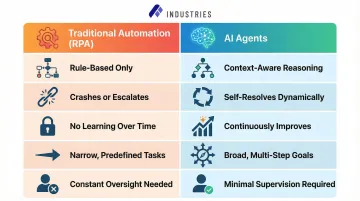
Traditional automation tools—RPA platforms, workflow engines, scripted bots—follow fixed, deterministic logic. They work reliably for structured, stable processes but break the moment they encounter an exception, a changed UI, or an unstructured input.
The RPA Maintenance Trap
Between 30-50% of initial RPA projects fail outright, and those that succeed consume 70-75% of total automation costs in maintenance and support. Why? RPA relies on coordinate-based screen scraping. When a vendor updates their portal or an ERP system changes a field name, the bot breaks immediately.
In a typical 50-bot deployment, UI changes can cause 8-12 automations to break weekly, consuming 250+ hours of IT staff time just to fix them.
How AI Agents Differ
AI agents handle ambiguity, interpret unstructured data (emails, PDFs, voice), recover from unexpected situations, and improve over time—making them resilient to the real-world messiness that traditional automation cannot tolerate.
| Capability | Traditional Automation (RPA) | AI Agents |
|---|---|---|
| Decision-Making | If-then rule execution | Context-based reasoning |
| Exception Handling | Breaks on deviation | Adapts and escalates when needed |
| Learning | Static after deployment | Improves continuously with data |
| Task Scope | Single-step actions | Multi-step workflow orchestration |
| Human Involvement | Heavy ongoing maintenance | Low oversight; flags judgment calls only |
The Financial Impact
Those capability differences translate directly to cost. Migrating from RPA to agentic AI reduces total cost of ownership by 57%. A traditional RPA deployment costing $1.4 million over three years drops to approximately $600,000 with an agentic platform—because maintenance costs plummet when agents self-heal rather than breaking on every UI change.
Where AI Agents Are Delivering Real Business Results
Finance and Accounting: From $19 to $2.36 Per Invoice
Finance teams operate in high-stakes environments where manual data entry and reconciliation create severe bottlenecks. AI-driven invoice processing reduces costs from $12.88-$19.83 per invoice manually to as little as $2.36—an 80% reduction. Processing speed jumps from 10-30 minutes to 1-2 seconds.
Beyond basic AP tasks, agentic AI transforms complex financial analysis. A global biotech deployed an AI agent to ingest contracts and invoices, verifying that all terms—early payment discounts, volume rebates—were correctly applied. The system identified contract leakage equal to approximately 4% of total spend, translating to $40 million in recurring margin improvement on a $1 billion spend base.
Key metrics from finance automation deployments:
- Invoice processing time: from 17.4 days to 3.1 days (82% faster)
- Invoice exception rate: from 22% to 9% (59% lower)
- Manual handling time: 40-60% reduction
Healthcare Operations: Cutting Prior Auth Times by 77.8%
Administrative costs consume $353 billion annually in US healthcare. Prior authorization is a primary driver—physicians complete an average of 41 PAs per week, consuming 13 hours of physician and staff time.
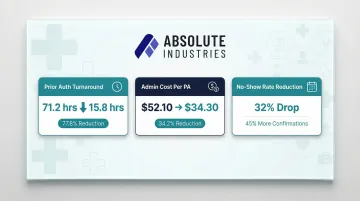
Machine learning-driven PA systems can auto-adjudicate 44.7% of eligible requests, reducing mean turnaround time from 71.2 hours to 15.8 hours—a 77.8% reduction. Administrative costs per PA request dropped by 34.2% (from $52.10 to $34.30).
AI appointment reminders using NLP to interpret patient replies reduced no-show rates by 32%, increased appointment confirmations by 45%, and decreased staff time on manual outreach by 40%.
HIPAA Compliance in Practice: Assembly Industries serves healthcare practices across family practice, cardiology, and orthopedics with a 99% HIPAA compliance rate, enforced through SOC 2-aligned security controls, TLS 1.2+/AES-256 encryption, role-based access controls, comprehensive audit logging, and 48-hour breach notification procedures.
Sales and Revenue Operations: 77% More Revenue Per Rep
Sales representatives spend 65-70% of their time on non-selling activities—CRM data entry, prospect research, email follow-ups. AI-enabled teams generate 77% more revenue per representative, and 83% of AI-enabled sales teams grew revenue in the past year, compared to just 66% of teams relying on manual processes.
Those revenue gains trace directly to how AI changes the prospecting process. Agentic AI replaces static lead scoring with signal-based selling—continuously monitoring intent data, firmographics, and trigger events such as leadership changes and funding rounds. The results are measurable:
- Signal-personalized outreach achieves 15-25% reply rates, versus 3-5% for generic cold email
- Research-to-outreach time drops from 15-30 minutes per prospect to under 60 seconds
- Waterfall enrichment (sequentially querying multiple data sources) pushes contact coverage from 50-70% to 85-95%
Customer Operations: 80% Autonomous Resolution by 2029
Gartner predicts that by 2029, agentic AI will autonomously resolve 80% of common customer service issues, leading to a 30% reduction in operational costs. Enterprise deployments already show 50% reductions in live agent chats within 30 days, 88% autonomous resolution rates, and 20% decreases in case resolution times.
The Cross-Functional Opportunity
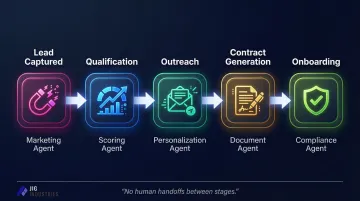
Connecting agents across functions compounds the gains from any single deployment. A lead captured in marketing automatically flows through qualification (scoring agent), outreach (personalization agent), contract generation (document agent), and onboarding (compliance agent), with no human handoffs at each step. That end-to-end chain is where enterprise teams are finding the largest productivity gains—and where point solutions consistently fall short.
From Point Solutions to End-to-End Orchestration
The Cost of Tool Sprawl
The average enterprise manages 1,061 different applications, yet only 29% are integrated. This fragmentation creates severe data silos, which 90% of organizations identify as a major business obstacle. Organizations spent an average of $4.7 million on custom integration labor in a single year.
This lack of connectivity is why AI initiatives fail. Gartner reports that 50% of generative AI projects are abandoned after proof-of-concept due to poor data quality, inadequate risk controls, and escalating costs. In fact, 86% of IT leaders warn that without proper integration, AI agents introduce more complexity than value.
The Orchestration Imperative
The next frontier isn't more AI agents—it's orchestration: a unified layer that connects AI agents, human oversight, and business systems into coherent, outcome-driven workflows.
Assembly Industries was built specifically for this problem — combining AI agents, expert human oversight, and secure automation infrastructure into a single orchestration layer that takes accountability for outcomes, not just tooling.
What to look for in an orchestration approach:
- End-to-end process ownership — a single provider accountable for results, from deployment through ongoing performance
- Outcome-based SLAs — contracts tied to resolution rates and cost targets, not server availability
- Real-time performance monitoring — dashboards tracking resolution times, SLA compliance, and ROI
- Human-in-the-loop oversight — skilled operators handling complex decisions and exceptions
- Enterprise security architecture — SOC 2 compliance, encryption standards, audit logging
Companies migrating from legacy integration platforms to modern orchestration report 20-65% lower TCO and 4-10x faster development speeds. The value comes from agents that share data across systems, escalate to humans when needed, and report directly against the business metrics that matter.
Frequently Asked Questions
What is the difference between AI agent and automation?
Traditional automation follows fixed rules and breaks when conditions change. AI agents reason through context, handle ambiguity, and adapt—making them capable of managing complex, variable workflows that rule-based tools cannot.
What are the 7 types of AI agents?
The seven types are: Simple Reflex, Model-Based Reflex, Goal-Based, Utility-Based, Learning, Hierarchical, and Multi-Agent Systems. Each suits a different level of task complexity, and most enterprises deploy combinations depending on the workflow.
Can AI agents replace human workers entirely?
AI agents excel at high-volume, repetitive, and data-intensive tasks but work best with human oversight for judgment-heavy or exception-heavy decisions. The most effective enterprise model is AI-first with humans focused on strategic and creative work.
What industries benefit most from AI agent automation?
Finance, healthcare, customer operations, and supply chain lead adoption. Any industry with high-volume, process-driven workflows stands to gain significant efficiency and cost advantages.
How do multi-agent systems work in enterprise settings?
Multi-agent systems assign specialized agents to different sub-tasks within a larger workflow. A coordinator agent breaks down the objective, delegates to the right agents, and consolidates the outputs. This structure lets enterprises automate complex, cross-functional processes end-to-end.
How should a company get started with AI agents for business automation?
Start by identifying structured workflows with clear inputs and outputs, then pilot a single agent use case before expanding. Working with an orchestration partner — rather than stitching together point solutions — avoids the fragmented results that sink most early automation efforts.