Introduction
Procurement teams today are drowning in manual workflows — vendor onboarding, PO approvals, contract reviews, compliance checks — while simultaneously facing pressure to deliver strategic value. 49% of procurement teams piloted generative AI in 2024, yet only 4% achieved large-scale deployment, revealing a massive gap between experimentation and execution.
AI agents close that gap in ways traditional automation cannot. Unlike rule-based systems that break on exceptions, AI agents autonomously plan, execute, and optimize multi-step procurement processes with minimal human supervision. They handle unstructured data, reason through novel situations, adapt from outcomes, and flag edge cases for human review. The result: procurement shifts from a reactive cost center into a strategic, data-driven function.
This guide covers what AI agents in procurement are, how they differ from older automation, the highest-ROI use cases, measurable benefits, implementation roadmaps, and how to choose the right platform.
Key Takeaways
- AI agents autonomously handle multi-step procurement tasks (vendor onboarding, contracts, PO processing) well beyond what traditional RPA can do
- Core use cases deliver immediate ROI: supplier management, strategic sourcing, contract lifecycle automation, spend visibility, and real-time risk monitoring
- Organizations achieve 25-40% efficiency gains and 60% cost reduction versus traditional staffing models when combining AI agents with expert human oversight
- Successful deployment requires orchestration platforms that connect AI, data systems, and human checkpoints end-to-end, not fragmented point solutions
- Start with high-impact pilots (PO automation, supplier onboarding), build clean data foundations, and choose platforms with outcome accountability
What Are AI Agents in Procurement?
AI agents in procurement are autonomous systems — typically powered by large language models (LLMs) — that perceive data inputs, reason through problems, make decisions, and execute actions across procurement workflows with minimal human intervention. Unlike basic chatbots or rule-based bots, AI agents can handle unstructured data (emails, PDFs, contracts), adapt to unfamiliar situations, and dynamically generate workflows without explicit programming.
How AI Agents Work
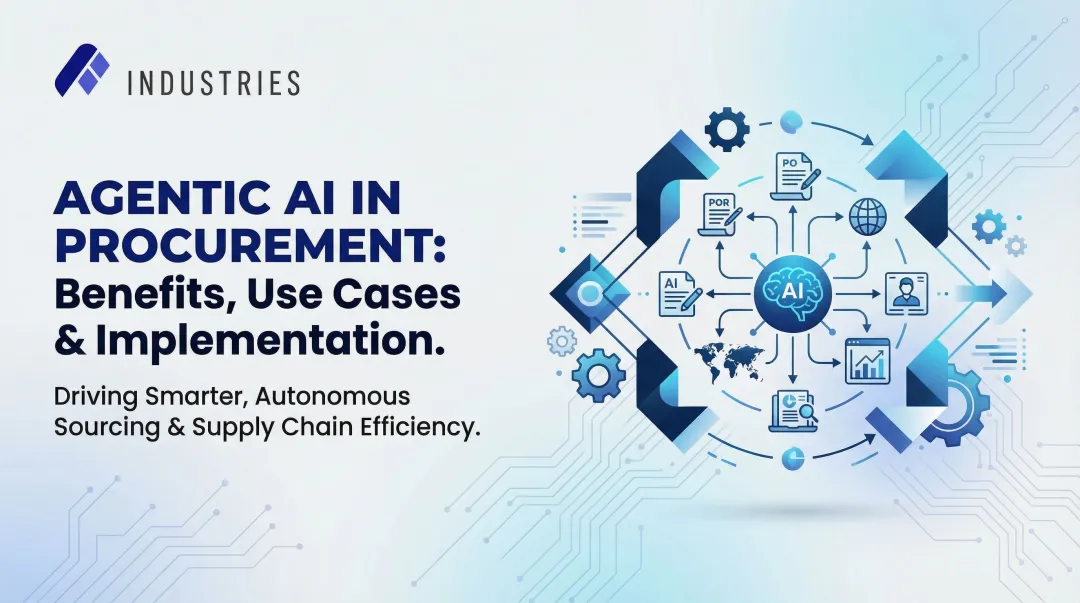
AI agents ingest both structured and unstructured data — supplier records, contracts, market intelligence, purchase history — then reason through objectives using LLMs. They use tool-calling capabilities to interact with ERP and procurement platforms, execute actions, and learn from outcomes. Multi-agent systems assign specialized subtasks to different agents coordinated through an orchestration layer, enabling complex end-to-end process automation.
Understanding how agents operate individually sets up a larger question: not all procurement AI works the same way, and the distinctions matter for deployment decisions.
The Spectrum of AI in Procurement
Procurement AI exists on a spectrum of sophistication:
- Predictive AI: Forecasts risks, demand patterns, and supplier performance issues
- Generative AI: Drafts RFPs, contracts, and supplier communications
- Agentic AI: Autonomously executes sourcing events, manages supplier onboarding end-to-end, and coordinates multi-step workflows across systems — without waiting for human prompts at each stage
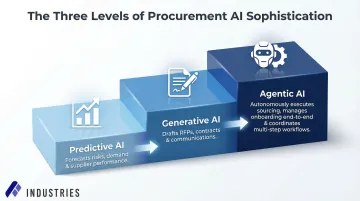
80% of Chief Procurement Officers plan to deploy generative AI over the next three years, and agentic AI is where that investment is converging — because it's the only tier that closes the loop from decision to execution.
Human-in-the-Loop: AI Agents as Assistants, Not Replacements
AI agents do not replace procurement professionals. They handle tactical execution: processing invoices, flagging contract anomalies, running supplier scorecards. Humans retain governance, strategic sourcing decisions, and supplier relationships. In practice, teams using this model typically reallocate 60–70% of manual processing time toward higher-value work rather than eliminating headcount.
Key Use Cases: Where AI Agents Transform Procurement
AI agents apply across the entire Source-to-Pay (S2P) lifecycle, but certain areas show the highest ROI and fastest adoption today.
Supplier Management and Onboarding
Traditional vendor onboarding averages 30 to 45 days and can extend to 3-6 months for complex enterprises. AI agents automate the full workflow: document collection, verification, compliance checks, and risk screening.
Real-world impact:
- A global manufacturing enterprise reduced onboarding from 35 days to 4 days (88% reduction) using AI-driven document understanding
- A top 10 pharmaceutical company cut supplier onboarding from 50+ hours to 6 hours per supplier
That speed advantage doesn't stop at onboarding. AI agents continuously monitor supplier KPIs, flag performance deviations, predict risk factors (geopolitical instability, financial health signals), and recommend corrective actions — all without manual reporting cycles.
Strategic Sourcing and Contract Management
Sourcing automation: AI agents gather supplier data, send RFIs/RFQs, score and compare bids objectively using predefined criteria, draft award recommendations, and conduct autonomous negotiations within set parameters. Organizations adopting AI report up to 30% faster sourcing cycles, compressing typical 8-10 week sourcing events significantly.
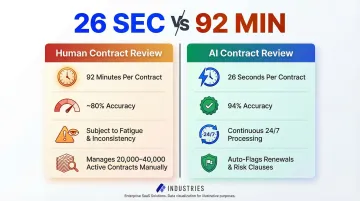
Contract management carries its own risk profile. Fortune 1000 companies manage 20,000 to 40,000 active contracts, and ineffective contract management causes 8.6-9.2% annual revenue erosion. AI agents handle this by auto-drafting from templates, monitoring compliance against terms, flagging renewal deadlines and risk clauses, and ensuring regulatory alignment. The speed difference is stark: AI contract review takes 26 seconds versus 92 minutes for human review, with 94% accuracy.
Purchase Order Automation and Spend Visibility
PO automation: The average organization spends $9.87 and takes 10.1 days to process a single manual invoice, with a 20.7% exception rate. AI agents auto-generate purchase orders from approved requisitions, route them through approval workflows, verify accuracy against inventory levels and historical data, and dispatch to suppliers — reducing manual errors and accelerating cycle times.
Tail spend is where the hidden costs pile up. Tail spend represents 20% of enterprise spend across 80% of suppliers, yet only 4% of companies actively manage it. AI agents track spending patterns across every category, flag maverick spending (which costs 12-18% more than compliant spend), and identify savings opportunities in previously unmanaged areas.
Risk Management and Compliance
Proactive risk management: Supply chain disruptions cost enterprises 6-10% of annual revenues. AI agents ingest external data (commodity prices, weather events, supplier financial signals, geopolitical developments) combined with internal procurement data to identify and flag supply chain disruptions before they occur — moving from reactive to predictive risk management.
Organizations lose 5% of revenue annually to occupational fraud, with procurement fraud among the top three economic crimes globally. AI agents continuously track transactions and procurement activities against regulatory requirements, flag anomalies, and generate audit trails — monitoring every transaction individually rather than relying on periodic human review.
Benefits of AI Agents in Procurement
Cost Reduction and Operational Efficiency
End-to-end AI automation can make procurement functions 25-40% more efficient. Digital World Class procurement organizations operate at 21% lower cost than peers — translating to a $6 million annual cost advantage for a typical $10 billion enterprise.
The cost gap between automated and manual procurement is stark:
- AI-first + human oversight models reduce operational costs by 60% or more versus traditional staffing, while improving quality and speed
- Best-in-class AP teams process invoices for $2.81 with an 11.1% exception rate — compared to $9.87 and 20.7% for average organizations
Faster Cycle Times and Response Speed
AI agents compress procurement cycle times across sourcing, approvals, and contract execution. Traditional processes rely on human availability and sequential task hand-offs. Agents run continuously, 24/7, enabling faster responses to market changes and supplier events. Best-in-class AP teams process invoices in 3.4 days compared to 10.1 days for average organizations.
Strategic Reallocation of Human Talent
Offloading repetitive, high-volume tasks to AI agents frees procurement teams to focus on supplier innovation, category strategy, and market intelligence. That shift elevates procurement from a transactional function to a strategic business driver. Spending managed per FTE is 50% higher today than five years ago, making automation essential to maintain that strategic focus.
AI Agents vs. Traditional Procurement Automation
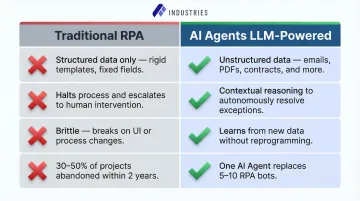
Traditional procurement automation (RPA, rule-based workflows, digitized forms) operates on rigid, pre-programmed rules and breaks down when encountering exceptions or unstructured data. Between 30-50% of enterprise RPA projects are abandoned within two years because they fail when handling unstructured data, which comprises 80-90% of enterprise data.
AI agents, by contrast, can reason through novel situations, handle unstructured inputs (emails, PDFs, contract language), and adapt their approach based on context and learning.
| Feature | Traditional RPA | AI Agents (LLM-Powered) |
|---|---|---|
| Input Type | Requires structured data (fixed formats, CSVs) | Handles unstructured data (emails, PDFs, contracts) |
| Exception Handling | Halts and escalates upon encountering variations | Uses contextual reasoning to resolve exceptions or request missing data |
| Adaptability | Brittle; breaks when UI or vendor formats change | Highly adaptable; learns from new data without reprogramming |
| Project Outcomes | 30-50% of projects abandoned within 2 years | Consolidates bot estates; one agent replaces 5-10 RPA bots |
Why Now?
The convergence of LLMs, enterprise API ecosystems, and cloud-based procurement platforms has made AI agents practical at scale. As recently as 2022, the underlying technology couldn't support autonomous multi-step procurement execution. Three developments changed that:
- LLMs can now interpret natural language instructions and contract terms without manual formatting
- Retrieval-Augmented Generation (RAG) enables contextual reasoning over enterprise data in real time
- Mature API ecosystems let agents execute actions across ERP, sourcing, and approval systems without custom integration work
How to Implement AI Agents in Your Procurement Workflow
AI agents should not be deployed broadly across all procurement functions simultaneously. A phased, outcome-focused implementation reduces risk and allows teams to build confidence and governance frameworks before scaling.
Start with a Pilot: Identify High-Impact, Low-Risk Use Cases
Begin with use cases where AI agents deliver clear, measurable value quickly — such as PO automation, supplier onboarding, or spend classification — rather than complex autonomous negotiation. Define success criteria upfront: cycle time reduction, error rate, cost savings.
Build a Clean Data Foundation
AI agent effectiveness is directly dependent on data quality. 70% of AI projects fail due to data quality issues. Organizations need clean, integrated procurement data across ERP systems, supplier databases, and contract repositories before agents can reason accurately. Only 26% of Chief Data Officers are confident their organization's data can support AI-enabled revenue streams, citing data accessibility, completeness, and accuracy as major barriers.
Resolve data fragmentation before scaling agent deployments — the statistics above are the outcome when you don't.
Choose an Orchestration Platform, Not Just a Point Solution
Most procurement AI tools solve one isolated problem — contract review OR supplier scoring. Connecting those isolated tools into a working system requires an orchestration layer — one that spans the full S2P workflow, integrates with existing systems, and maintains complete audit logging throughout.
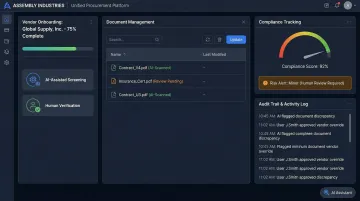
Assembly Industries takes this approach directly. Rather than adding another point tool to an already fragmented stack, Assembly connects procurement functions into a single managed system — with AI agents, expert human oversight, SOC 2-compliant infrastructure, and outcome-based SLAs. That unified coverage spans:
- Vendor onboarding and qualification
- Document management and contract reviews
- Compliance tracking and billing audits
- End-to-end visibility with audit logging
Establish Governance, Human Oversight, and Change Management
Governance framework: Establish escalation protocols for exceptions, human review checkpoints for high-value decisions, audit logging, and ongoing performance monitoring.
Change management: Procurement teams need training and clear communication about how their roles evolve alongside AI agents, not against them. 95% of generative AI pilots are failing due to flawed enterprise integration and lack of change management, not model quality issues. Teams that invest in structured onboarding — with clear feedback loops and defined escalation paths — reach stable, reliable agent performance faster than those that treat deployment as a one-time event.
Frequently Asked Questions
Frequently Asked Questions
How to use AI agents in procurement?
AI agents can be deployed across supplier onboarding, purchase order automation, contract management, and spend analytics — typically starting with a focused pilot before scaling. Choose a platform that integrates with your ERP, includes human oversight checkpoints, and holds vendors accountable for outcomes, not just access.
Can procurement be done by AI?
AI agents can autonomously handle many tactical tasks — sourcing, PO processing, and compliance monitoring. The most effective model pairs AI execution with human oversight for strategic decisions and supplier relationships. Full end-to-end AI-only procurement is not yet the standard.
Which AI agent platform is best for enterprises?
The best enterprise platforms offer end-to-end orchestration across the full Source-to-Pay lifecycle, integrate securely with ERP, CLM, and SRM systems, and hold SOC 2 or equivalent security compliance. Prioritize vendors accountable for results, not just tool deployment.
Which AI is best for procurement?
Agentic AI — built on LLMs with multi-agent orchestration — is currently the strongest category for procurement automation. Unlike rule-based or predictive tools, it handles both structured tasks like PO processing and judgment-intensive work like bid evaluation, negotiation, and risk assessment.
What is the difference between AI agents and traditional procurement automation?
Traditional automation (RPA) follows rigid, pre-programmed rules and fails on exceptions. AI agents can reason through novel situations, process unstructured data, adapt to new information, and execute multi-step workflows end-to-end with far less human intervention.
What are the biggest challenges of implementing AI agents in procurement?
Poor data quality tops the list — agents need clean, integrated data to reason accurately. Organizational resistance is the second hurdle, requiring clear communication and upskilling. The third is choosing point solutions over orchestration platforms, which multiplies integration complexity instead of reducing it.