Introduction
Most enterprise operations are running on processes that weren't built for today's scale. As organizations grow, process complexity compounds, labor costs climb faster than productivity gains, and the pressure to deliver more with tighter headcount intensifies every quarter. For many teams, manual workflows are the bottleneck they can't afford to ignore.
AI workflow orchestration addresses that bottleneck directly — replacing fragmented, labor-intensive processes with coordinated, automated execution that produces measurable outcomes. The business case isn't theoretical. Enterprises that deploy orchestration at scale report reductions in error rates, faster cycle times, lower operational costs, and stronger regulatory compliance.
This article breaks down the specific returns: where orchestration cuts costs, how it improves throughput and accuracy, and why it's becoming a core operational investment for enterprise decision-makers.
Key Takeaways
- AI workflow orchestration coordinates complete business processes using AI agents, managing sequences, dependencies, and decisions across teams and systems
- Delivers 60–70% cost reduction versus traditional staffing models while improving execution quality and speed
- Point solutions create hidden costs — inconsistent outcomes, operational bottlenecks, and compliance gaps that a unified orchestration layer resolves
- Each additional workflow added to an orchestration platform costs less to implement, making ROI stronger as adoption scales
- Platforms with AI agents, human oversight, and outcome-based SLAs deliver the most consistent, measurable business results
What Is AI Workflow Orchestration?
AI workflow orchestration is the intelligent coordination of tasks, decisions, handoffs, and systems across complete business processes — not merely automating individual steps, but ensuring entire workflows execute correctly from start to finish, including every handoff in between. Forrester defines this evolution as "Adaptive Process Orchestration (APO)," distinguishing it from traditional RPA by its use of AI agents and adaptive decision logic that makes autonomous decisions to meet business goals.
Where orchestration applies:
- Multi-step processes spanning departments (revenue cycle management, procurement, customer onboarding)
- Workflows requiring conditional logic or approvals (contract reviews, compliance certifications)
- Operations demanding integration across software tools (ATS, HRIS, ERP, CRM systems)
- Processes with regulatory requirements (HIPAA healthcare workflows, financial services compliance)
In each of these scenarios, the goal is the same: producing consistent, measurable business results — not simply running AI tools. That's what separates orchestration platforms from point-solution RPA tools, which handle isolated tasks well but leave process coordination to human managers who then become the bottleneck.
Key Advantages of AI Workflow Orchestration
The three advantages below are grounded in operational and financial outcomes enterprise leaders track, not theoretical capabilities. Each delivers maximum value when applied consistently across high-volume or high-stakes business processes.
Advantage 1: Dramatic Cost Reduction Without Sacrificing Execution Quality
AI workflow orchestration reduces costs by replacing labor-intensive, manually-coordinated processes with AI-driven execution that handles routing, decisions, and handoffs automatically, typically at a fraction of traditional staffing costs.
How this works in practice:
Orchestration eliminates overhead from managing multiple disconnected vendors or point solutions, reduces rework caused by miscommunication or process gaps, and enables small teams to manage workflows that previously required significantly larger headcount.
Forrester's Total Economic Impact study on Celonis found that automated invoice processing saved 62 full-time equivalents, with deliveries processed without human intervention increasing from 33% to 86%.
Why this matters:
McKinsey case studies document savings opportunities ranging from 20% to 29% in BPO and financial services operations through agentic AI adoption. Assembly Industries' AI-first model with human oversight achieves up to 70% cost reduction compared to equivalent US-based hiring.
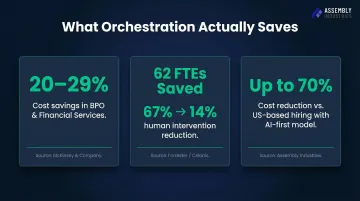
At that scale, cost reduction shifts the build vs. buy calculus and frees budget for strategic initiatives.
A Harvard Business Review analysis estimates bad data costs the U.S. $3 trillion annually. Orchestration directly mitigates this through improved data quality, automated validation, and reduced manual errors.
KPIs impacted:
- Cost per process
- Fully-loaded labor cost
- Cost-to-serve per customer or transaction
- Process overhead as percentage of revenue
When this advantage matters most:
Cost advantages are most pronounced at scale: high-volume transactional processes (billing, claims, onboarding, data entry), multi-vendor coordination environments, and organizations expanding into new markets without wanting to scale headcount linearly.
Advantage 2: Consistent Accuracy, Reduced Error Rates, and Built-In Compliance
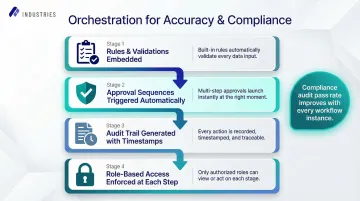
Orchestration enforces process rules uniformly across every workflow instance, eliminating variability from human judgment on routine tasks, handoff delays, and missed steps.
How orchestration creates this advantage:
Rules, validations, approval sequences, and compliance checks are embedded directly into workflow logic, executing identically whether processing 10 transactions or 10,000. The HIPAA Security Rule (§164.312) requires centralized audit trails and role-based access control. Orchestration platforms deliver both natively through time-stamped logs and automated access enforcement at each workflow step.
Why this matters:
The financial cost of manual errors is substantial. The U.S. Government Accountability Office reported $161.5 billion in improper payments across federal agencies in fiscal year 2024. In healthcare specifically, initial claim denial rates have risen to nearly 12%, with the administrative cost per denied claim reaching $57.23 in 2023.
For regulated industries — healthcare (HIPAA), finance, or enterprise procurement — the audit trail and consistent documentation orchestration provides isn't just operationally useful. It's often a compliance requirement.
KPIs impacted:
- Error rate per process
- Rework rate
- Compliance audit pass rate
- SLA adherence
- Documentation completeness
When this matters most:
Accuracy and compliance advantages are highest in industries with regulatory exposure (healthcare revenue cycle, financial services, legal), high-volume repetitive processes, and organizations that have experienced costly errors or audit findings due to manual process gaps.
Advantage 3: Scalability with Real-Time Visibility Across Operations
AI workflow orchestration separates operational capacity from headcount, so businesses can scale process volume and complexity without proportional increases in staffing, management overhead, or coordination effort.
How this works in practice:
Orchestration platforms auto-route tasks, manage workloads dynamically, flag exceptions in real time, and provide live dashboards on process status, throughput, and bottlenecks. Leadership gains visibility to act on current operational data, not lagging reports.
A Forrester TEI study on SymphonyAI ITSM documented 35% ticket deflection rates and 75% average handling time reduction, with Mean Time To Resolution (MTTR) dropping by two hours.
Why this matters:
A peer-reviewed 2021 case study showed SLA adherence improving from 87% to 95% through real-time, event-driven orchestration with latency under 30 seconds (down from 6–12 hours). That agility means businesses can pursue new customers, markets, or product lines without rebuilding operational infrastructure each time. IDC projects global AI investment will reach $423 billion by 2027, with the Intelligent Process Automation market reaching $65.3 billion at a 21.7% CAGR.
KPIs impacted:
- Process throughput
- Time-to-completion per workflow
- Exception resolution time
- Operational capacity utilization
- Management reporting lag
When this matters most:
Scalability benefits are most critical during rapid growth periods, seasonal volume spikes, geographic expansion, or when transitioning from manual-heavy operations to automated models. Visibility becomes especially valuable when managing complex, multi-team workflows with high dependency chains.
What Happens When AI Workflow Orchestration Is Missing or Ignored
Fragmented point solutions, manual coordination, and disconnected automation tools carry a real operational cost: inconsistent process outcomes, high rework rates, and reactive firefighting that consumes management bandwidth.
How Orchestration Gaps Compound at Scale
As businesses scale, orchestration gaps grow faster than headcount. More handoffs mean more errors, more tools mean more brittle integrations, and more complexity means slower response times and harder-to-audit compliance trails.
A Deloitte MarginPLUS study of nearly 300 senior executives found that half cited legacy technology infrastructure as a barrier to efficiency — forcing manual handoffs and ongoing data reconciliation.
The Competitive Risk of Delayed Adoption
Enterprises that delay adoption fall behind on cost efficiency, delivery speed, and customer experience — while orchestration-enabled competitors pull ahead. According to a 2025 McKinsey report, only 23% of organizations have scaled an agentic AI system in at least one business function, while 39% remain in piloting or experimentation phases. Gartner predicts that by end of 2026, 40% of enterprise applications will integrate task-specific AI agents, up from less than 5% in 2025.
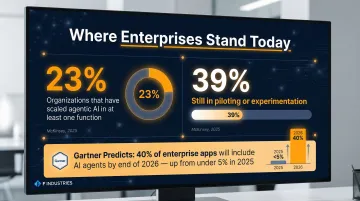
Organizations without orchestration face:
- Tool sprawl that accumulates into costly, brittle webs of custom integrations
- Skilled personnel diverted to reactive firefighting instead of strategic work
- Reduced agility when adapting to market shifts that orchestrated competitors handle faster
- Slower, disjointed internal processes that surface directly as poor service delivery
How to Get the Most Value from AI Workflow Orchestration
Most organizations that underperform on AI investments do so not because the technology failed — but because they automated in fragments. Orchestration delivers outsized returns when it covers complete, end-to-end workflows rather than isolated tasks. Connecting the full process chain is what separates meaningful ROI from incremental efficiency gains.
Monitor Continuously, Not Just at Launch
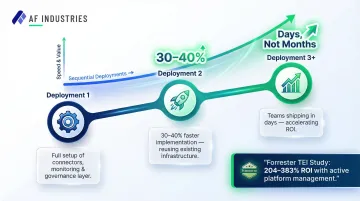
Real-time visibility only pays off when performance data is reviewed regularly and used to refine workflows. Orchestration requires ongoing operational discipline — not a one-time implementation. Forrester TEI studies consistently show payback periods under 6–12 months when organizations actively manage their orchestration platforms, with ROIs ranging from 204% to 383%.
Choose Platforms That Own Outcomes
The fastest, most reliable results come from working with platforms that take accountability for outcomes — not just tools that hand you software and step back. Assembly Industries, for example, operates on outcome-based contracts and SLAs, combining AI agents with expert-vetted human oversight so orchestration is actively managed rather than passively deployed.
Start with High-Impact Processes
Prioritize workflows with:
Build Composable Infrastructure
Organizations that move beyond point solutions and invest in orchestration infrastructure compound value with every use case added. Each new workflow benefits from the same connectors, monitoring layer, and governance structure already in place. The second deployment is typically 30–40% faster than the first — and by the third, teams are shipping in days.
Conclusion
AI workflow orchestration delivers a straightforward business case: each automated workflow reduces costs, improves accuracy, and builds operational infrastructure that scales in ways manual processes simply cannot.
Orchestration is an ongoing operational strategy rather than a one-time technology purchase. The enterprises that benefit most are those that treat it as a continuous investment in how work gets done, reviewed, and improved — and who choose partners accountable for outcomes, not just implementation.
The competitive advantage compounds over time. Early adopters establish operational infrastructure that accelerates with each new use case, while organizations that delay accumulate integration debt and steadily widen the cost gap between themselves and competitors who moved first. The question isn't whether to orchestrate — it's how quickly you can start doing it well.
Frequently Asked Questions
What are the benefits of implementing an AI orchestrator workflow?
Primary operational benefits include 60-70% cost reduction versus traditional staffing models, improved process consistency through embedded rules and validations, measurably lower error rates, and the ability to scale workflows without proportional headcount growth — all tied to measurable business outcomes like cost per transaction, SLA compliance, and throughput.
How can AI agents improve efficiency in IT workflows?
AI agents handle routine IT workflow tasks (ticket routing, incident escalation, provisioning approvals) autonomously, reducing manual intervention. Forrester studies document 35% ticket deflection rates, 75% average handling time reduction, and MTTR improvements of 2+ hours, freeing IT teams to focus on higher-value work like architecture and innovation.
What is the difference between AI workflow automation and AI workflow orchestration?
Automation handles individual task execution — processing an invoice, screening a resume — while orchestration manages the entire end-to-end process, including sequencing, dependencies, decision routing, and cross-system handoffs. In short: orchestration coordinates the tools; automation runs the individual steps within them.
What industries benefit most from AI workflow orchestration?
Industries with high-volume, compliance-sensitive processes see the greatest gains — healthcare, financial services, and enterprise IT operations among them. Examples include KYC onboarding cut from 16 days to 2, healthcare claim denial rates at 12%, and IT operations delivering 204-356% ROI. Any sector running complex, multi-step workflows is a strong candidate.
How long does it take to implement AI workflow orchestration?
Managed orchestration providers typically reach go-live in about 3 months, with payback periods under 6-12 months per Forrester TEI models. In-house builds generally require over a year before hitting production — making a provider-led approach the faster path to ROI.
What should businesses look for when choosing an AI workflow orchestration platform?
Key criteria to evaluate:
- End-to-end process coverage — not just point-solution automation
- Security certifications — SOC 2 compliance and HIPAA readiness
- Real-time monitoring and reporting across all workflows
- Integration breadth across your existing enterprise systems
- Outcome accountability — SLA-backed contracts, not just technology licensing