Introduction
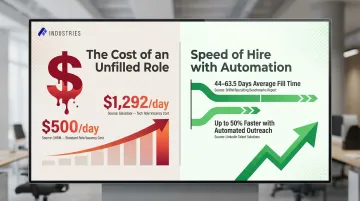
Modern recruitment teams operate under relentless pressure: shrinking response windows, passive candidate pools, and the mounting cost of a slow hiring pipeline. Every day a position remains vacant costs an organization approximately $500 in lost productivity, scaling up to $1,292 per day for specialized technical roles. With top candidates available for only 10 days before accepting other offers, the recruiter who reaches a candidate first holds a decisive advantage.
Despite the volume of digital outreach, phone calls remain the most direct channel for candidate engagement. Email campaigns average roughly 5% response rates; cold calls deliver 8-12% — and they enable real-time clarification on scheduling, pay expectations, and interpersonal fit that email simply can't provide.
The problem is execution. Most recruitment teams burn hours on manual dialing, voicemails, unanswered calls, and repetitive data entry that leaves little time for actual conversations.
Automated outbound calling changes that equation. Used well in recruitment, it compresses time-to-interview, lifts response rates, and frees recruiters to focus on the conversations that actually move candidates forward.
Key Takeaways
- Automated outbound calling eliminates manual dialing, voicemail drops, and chasing non-responsive candidates at scale
- Recruiters only engage when candidates are live and interested — more conversations, less wasted time per hire
- Consistent, structured call scripts ensure every candidate receives the same quality outreach regardless of volume
- Speed to first contact is a critical differentiator—89% of candidates accept job offers faster when contacted promptly
- High-volume hiring pushes become manageable when outreach scales automatically without adding headcount
What Is Automated Outbound Calling for Recruitment
Automated outbound calling is software that dials candidate phone numbers from a list without manual dialing, routes live answers to recruiters or AI agents, and handles unanswered calls with pre-configured follow-up actions. Rather than a recruiter manually clicking "dial" for each contact, the system initiates calls automatically, filters out voicemails and busy signals, and connects recruiters only when a candidate answers live.
This technology fits across multiple recruitment workflow stages:
- Candidate sourcing follow-up — reaching out to newly identified talent before interest cools
- Interview scheduling — confirming availability and logistics without back-and-forth email chains
- Passive talent reactivation — re-engaging candidates who previously showed interest
- Pipeline status updates — keeping candidates informed throughout the hiring process
It's not limited to cold outreach. Automated calling accelerates every touchpoint where a live conversation moves things forward faster than email.
The distinction worth drawing: this isn't about placing more calls per hour. Faster pipeline movement, higher candidate engagement rates, and compressed time-to-fill are what automated calling actually delivers — and those are the metrics that drive hiring decisions.
Key Advantages of Automated Outbound Calling for Recruitment
The advantages below are grounded in operational outcomes that hiring teams and talent acquisition leaders actually track: cost per hire, time to fill, recruiter utilization, and candidate response rates. These aren't theoretical benefits—they're measurable improvements that directly impact your bottom line.
Advantage 1: Faster Speed to Candidate Engagement
Automated systems can initiate outreach to hundreds of candidates within minutes of sourcing, versus a recruiter working through a list one by one over hours or days. Auto-dialing eliminates idle time between calls, handles unanswered calls automatically, and routes live answers immediately to a recruiter or AI screener—compressing the time between candidate identification and first conversation.
The competitive edge:
In competitive hiring markets, the recruiter who reaches a candidate first has a significant advantage. Research shows that 89% of candidates accept job offers faster when a recruiter contacts them promptly. Candidates who receive a response within two days of applying are significantly more likely to accept interviews and job offers.
Every day a requisition stays open carries a cost. With the average time-to-fill hovering between 44 and 63.5 days, vacant roles cost organizations an average of $500 per day in lost productivity, scaling to $1,292 per day for specialized tech roles. Automated outreach can reduce time-to-hire by up to 50%, directly addressing this financial drain.
KPIs impacted:
- Time-to-first-contact
- Interview scheduling rate
- Time-to-fill
- Offer acceptance rate
When this advantage matters most:
High-volume hiring campaigns, seasonal workforce ramps, competitive talent markets, or any situation where multiple recruiters are sourcing from the same candidate pool.
Advantage 2: Recruiter Productivity and Scale Without Proportional Headcount Growth
A recruiter manually dialing a list spends the majority of active dialing time on non-productive actions: ringing unanswered calls, leaving voicemails, navigating hold queues, or re-dialing bad numbers. Automated systems absorb all of that wasted time. Predictive and power dialers ensure recruiters are almost always in live conversation rather than waiting, effectively multiplying the number of meaningful candidate touchpoints per recruiter per day.
The productivity math:
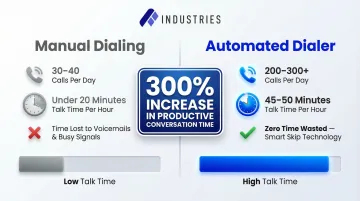
Manual dialing is highly inefficient. Recruiters manually dialing typically complete only 30-40 calls per day, resulting in less than 20 minutes of actual talk time per hour due to busy signals and voicemails. By implementing power or predictive dialers, recruiters can increase talk time to 45-50 minutes per hour—a 300% increase in productive conversation time.
This directly affects cost per hire. If automation allows a team of 3 recruiters to handle the candidate outreach volume of 8-10, the cost reduction is measurable. Assembly Industries pairs automated calling infrastructure with human recruiter oversight to handle that scale—its AI-first model has delivered 60% cost reductions compared to traditional BPO approaches, without sacrificing quality or speed.
KPIs impacted: calls per recruiter per hour, live connect rate, cost per hire, recruiter utilization rate
When this advantage matters most:
Staffing agencies handling multiple client pipelines, enterprise talent teams running simultaneous campaigns across business units, or any hiring team under pressure to scale without budget to add recruiters.
Advantage 3: Consistent Candidate Experience and Structured Data Capture
Automated calling systems deliver scripted, structured outreach that ensures every candidate hears the same core message, is asked the same qualifying questions, and receives the same follow-up cadence—eliminating variability caused by recruiter fatigue, style differences, or workload.
Call recordings, response logging, and CRM/ATS integrations automatically capture disposition data from every interaction. Recruiters and hiring managers get full pipeline visibility without relying on manual notes.
Why consistency is a compliance and quality issue:
Consistency in outreach protects against compliance risk by ensuring no candidate group receives preferential or inconsistent treatment. The EEOC's Uniform Guidelines on Employee Selection Procedures require that selection processes be consistent and avoid adverse impact on protected groups. Automated systems ensure every candidate is asked the exact same questions in the exact same manner, reducing human inconsistency and supporting uniform selection procedures.
Additionally, while a 2024 federal court ruling found that recruitment messages are not "solicitations" under the TCPA, the FCC continues to levy massive fines—including a $5.1 million fine for unlawful robocalls—for autodialer and prerecorded voice violations. Structured systems with proper consent management protocols mitigate these risks.
Data capture also enables optimization. Teams can identify which scripts get higher engagement, which times of day produce better connect rates, and which candidate segments convert. Organizations utilizing predictive hiring analytics report a 40-60% reduction in time-to-hire and a 25% higher first-year retention rate compared to traditional methods.
KPIs impacted:
- Candidate response rate
- Screening completion rate
- Data quality in ATS
- Compliance incident rate
- Pipeline conversion rates by segment
When this advantage matters most:
Any hiring operation with multiple recruiters, high-volume campaigns where consistency is critical, or organizations with regulatory sensitivity around equitable hiring practices. At high volume, even small inconsistencies in screening questions or follow-up timing compound into compliance exposure and skewed pipeline data.
What Happens When Recruitment Calling Stays Manual
Relying on manual outbound calling creates compounding consequences that erode hiring effectiveness over time:
Slow pipeline movement: Recruiters burn hours on non-productive dialing, candidates go cold waiting for first contact, and time-to-fill stretches beyond acceptable thresholds. With 36% of candidates disengaging at the one-month mark and 12% abandoning the process after just one week, delays are indistinguishable from rejection.
Inconsistent follow-up: Candidates fall through the cracks when recruiters are overloaded, leading to lost talent and a poor employer brand impression. Currently, 44% of candidates admit to ghosting employers, and when candidates feel ignored, 94% will retaliate by ghosting the employer in return. Poor communication permanently damages employer brand, especially when 83% of job seekers research company reviews before applying.
Inability to scale on demand: A sudden hiring surge—a new product launch, rapid headcount expansion—cannot be met by a fixed-capacity manual calling team, forcing expensive contract recruiting or missed hiring windows. Every missed window has a direct cost: delayed revenue, stalled projects, and offers accepted by competitors.
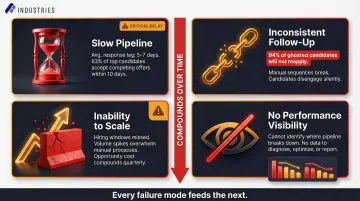
No visibility into outreach performance: Without call data, leadership cannot distinguish between a weak candidate pool and a weak outreach effort, making it impossible to diagnose and fix pipeline problems. That ambiguity makes meaningful improvement nearly impossible.
Each of these gaps compounds the others — and all of them are addressable through automated outbound calling.
How to Get the Most Value from Automated Outbound Calling in Recruitment
Automation delivers the most impact when it's connected to the full recruitment workflow, not dropped in as an isolated tool. Integration with your ATS ensures call dispositions update candidate status in real time and trigger the right next step—whether that's scheduling an interview, sending a follow-up email, or routing a qualified candidate to a hiring manager.
The value compounds when call scripts and outreach sequences are regularly reviewed against performance data. Teams that consistently analyze and act on key metrics improve outreach efficiency faster than those running static campaigns:
- Connect rates — identify which time windows and contact methods reach candidates most reliably
- Drop rates — flag scripts or call lengths causing candidates to disengage early
- Conversion by script version — determine which messaging moves candidates to the next stage
For organizations that want both automation infrastructure and outcome accountability, Assembly Industries' orchestration model provides reliable, scalable candidate outreach without requiring an internal tech build. Assembly pairs AI-driven calling with recruiter oversight and real-time performance monitoring—covering pre-screening, skills assessments, ATS updates, and multilingual outreach—so teams scale their pipeline without a proportional increase in headcount.
Conclusion
The real value of automated outbound calling in recruitment comes down to three things: reaching candidates before competitors do, handling volume without proportional recruiter cost, and giving every candidate a quality, trackable touchpoint.
These advantages compound with each hiring cycle. Teams that build consistent, data-driven outreach become faster and more cost-efficient over time. In a market where top candidates disappear in 10 days and every vacant role costs $500 per day, automation isn't a nice-to-have. It's the baseline for staying competitive.
Frequently Asked Questions
What is automated outbound calling?
Automated outbound calling uses software to dial contacts from a list without manual input, routing live answers to agents or AI screeners and handling unanswered calls automatically. This removes idle time from the outreach process so recruiters spend their hours on live conversations, not dial tones.
What are the benefits of automated outbound calling for recruitment?
The core benefits are faster candidate contact (minutes instead of days), higher recruiter productivity (45–50 minutes of talk time per hour versus under 20 minutes manually), and consistent outreach at scale. Structured data capture across all calls also improves pipeline visibility and enables ongoing optimization.
How does recruitment automation improve the hiring process?
Recruitment automation compresses the time between candidate identification and first conversation. It eliminates missed follow-ups from manual errors and frees recruiters to focus on relationship-building and strategic hiring decisions rather than administrative dialing.
Do companies use AI for recruiting calls?
Yes, AI-powered voice agents are increasingly used for initial candidate outreach, screening calls, and interview scheduling. 67% of Fortune 500 companies now use voice AI in recruiting, handling structured conversations at scale before routing engaged candidates to human recruiters. These systems operate 24/7 and can conduct pre-screening in multiple languages.
What are the two types of outbound calls?
Cold calls are first-time outreach to candidates who have not previously engaged with your organization. Warm calls are follow-up outreach to candidates who have already shown interest or previously applied. Automated systems handle both differently — cold calls require consent management and structured scripting, while warm calls draw on prior interaction data to personalize the outreach.
What skills are needed for outbound calls in recruitment?
Automation handles the mechanical tasks — dialing, voicemails, pacing — so recruiters can direct their energy toward active listening, candidate engagement, objection handling, and representing the employer brand in live conversations. When the dialpad is no longer a distraction, the recruiter's job becomes entirely about people.