Introduction
Managing vendors today has become a high-stakes balancing act for enterprise procurement teams. A typical Fortune 1000 company juggles between 20,000 and 40,000 active contracts simultaneously, yet procurement staff manage just 11.7 active suppliers per full-time equivalent. This mathematical mismatch creates a perfect storm: manual processes lead to 11% contract value leakage, missed renewals, compliance blind spots, and slow decision-making when speed matters most. Email chains multiply, spreadsheets pile up, and critical supplier risks go undetected until they explode into operational crises.
AI-powered vendor management changes this equation by automating the work that buries procurement teams. This article covers the real-world use cases enterprises are deploying today—automated onboarding, contract analysis, and predictive risk management—along with the measurable benefits and practical steps for implementation that fit existing workflows.
Key Takeaways
- AI in vendor management automates onboarding, contract extraction, performance tracking, spend monitoring, and compliance checks through machine learning and autonomous agents
- Enterprises achieve 25-40% efficiency gains, reduce onboarding time from weeks to days, and plug millions in contract value leakage
- Implementation barriers include fragmented data across systems, integration complexity with ERPs, and team adoption resistance
- Pilot in one high-friction area first, then scale using a unified orchestration platform — not disconnected point solutions
What Is AI-Powered Vendor Management?
Vendor management encompasses the end-to-end process of sourcing, onboarding, monitoring, and optimizing supplier relationships. Traditionally, this meant procurement teams drowning in email chains, manually tracking contracts in spreadsheets, and conducting annual compliance audits that discovered problems months too late.
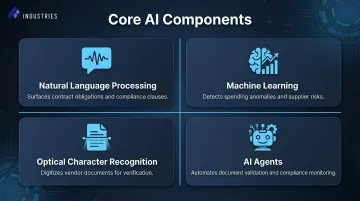
AI-powered vendor management transforms this reactive, manual approach into a continuous, intelligent system. The core technologies driving this shift:
- Natural Language Processing (NLP): Surfaces buried contract obligations, renewal deadlines, and compliance clauses from unstructured documents — without manual review
- Machine Learning (ML): Detects spending anomalies and flags supplier performance risks before they become operational problems
- Optical Character Recognition (OCR): Digitizes vendor-submitted documents for automated verification
- AI Agents: Handle document validation, compliance monitoring, and performance flagging without manual intervention
Basic automation makes processes faster — think robotic data entry and automated emails. AI makes them smarter: it learns from data, adapts to new patterns, and improves over time without being reprogrammed. That distinction matters because the bar to deploy true AI is significantly higher than plugging in an automation tool. Only 4% of procurement teams achieved large-scale AI deployment in 2024, despite 49% piloting projects — most underestimated the foundational work required to move beyond point solutions.
Key Use Cases of AI in Vendor Management
These are the five areas where AI delivers the clearest, most measurable results in vendor management—each backed by documented enterprise outcomes.
Automated Vendor Onboarding
Manual vendor onboarding takes 5-7 days on average and costs up to $20,000 per vendor due to repeated document review cycles, compliance verification delays, and administrative overhead. Complex integrations in regulated industries can stretch to six months.
AI cuts these timelines sharply. Automated systems scan and verify vendor-submitted tax forms, certifications, and insurance documents, cross-reference third-party databases for compliance status, and flag missing or mismatched data in real-time. One insurance company reduced partner onboarding from six months to just two weeks using governed multi-agent AI systems with human-in-the-loop validation.
For global supply chains, AI onboarding platforms collect documents in 74+ languages, perform instant identity verification, and route approved vendors directly into procurement systems—eliminating the email ping-pong that buries procurement teams.
Contract Analysis and Obligation Tracking
Enterprise contracts govern every dollar of spend, yet they're often siloed in legal departments, disconnected from procurement operations. This fragmentation leads to unmanaged auto-renewals and millions in missed obligations.
AI-native Contract Lifecycle Management (CLM) platforms use NLP and OCR to automatically extract:
- Renewal dates and auto-renew clauses
- Payment terms and volume discounts
- Liability provisions and indemnification requirements
- Non-standard language requiring legal review
Advanced models flag upcoming renewals months in advance, identify contracts with unfavorable terms, and track obligation fulfillment across thousands of agreements simultaneously. In one case, a global pharmaceutical company deployed AI-based invoice-to-contract reconciliation and identified over $10 million in value leakage within four weeks, prompting immediate supplier renegotiations.
Vendor Performance Monitoring
Supplier performance issues often go undetected until they cause production stoppages, expedited shipping costs, or stockouts. Traditional quarterly business reviews arrive too late to prevent disruption.
AI agents continuously track supplier KPIs—delivery rates, quality scores, responsiveness—against contracted SLAs. When performance dips below thresholds, the system surfaces early warnings and recommends corrective actions, shifting teams from reactive firefighting to proactive management.
One global manufacturer using AI-powered supply chain risk management achieved a 96.8% reduction in disruption response time—from 60+ hours to just 2 hours—resulting in $950,000 in cost savings within six months.
Spend Analysis and Cost Optimization
Maverick spend—purchases made outside approved contracts or suppliers—drains 5-16% of targeted procurement savings annually. This leakage occurs when buyers don't know preferred suppliers exist, contracts lack visibility, or purchasing approval workflows fail.
AI spend analytics closes these gaps by automatically:
- Categorizing every transaction and flagging off-contract purchases
- Identifying pricing deviations from negotiated terms
- Spotting missed volume discounts and redundant vendor relationships
- Analyzing historical patterns to surface consolidation opportunities
One mid-sized manufacturer analyzed 7,500 suppliers and uncovered $1.2 million in duplicate spending. Another organization deployed AI across spend analytics, PO processing, and forecasting to reduce total procurement costs by 25% in six months—$4.2 million in annual savings.
Risk and Compliance Monitoring
Vendor compliance failures carry staggering costs. In 2023, the UK's Information Commissioner fined outsourcing giant Capita £14 million (approximately $18 million) following a cyberattack that exposed 6.6 million people's personal data. Legacy rules-based Anti-Money Laundering (AML) and sanctions screening systems generate up to 95% false positives, burying compliance teams in meaningless alerts.
AI-powered monitoring addresses this directly. One Spanish bank deployed AI overlay technology and achieved a 91.8% reduction in false positives across customer and transaction screening, freeing analysts to focus on genuine threats.
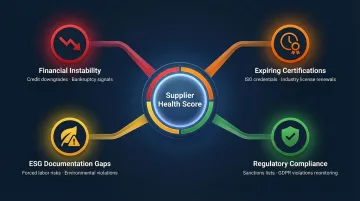
AI agents continuously monitor vendors for:
- Financial instability signals (credit rating downgrades, bankruptcy filings)
- Expiring certifications (ISO, industry-specific credentials)
- ESG documentation gaps (forced labor risks, environmental violations)
- Regulatory compliance issues (sanctions lists, GDPR violations)
The system assigns health scores and issues early alerts, replacing scrambling at audit time with proactive risk management. This capability is critical for emerging regulations like the US Uyghur Forced Labor Prevention Act and EU Corporate Sustainability Due Diligence Directive, which require deep supply chain visibility.
Top Benefits of AI in Vendor Management
Significant Time and Cost Savings
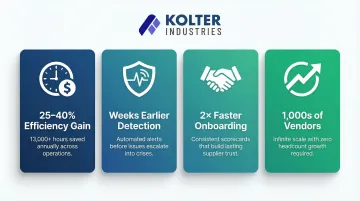
AI eliminates hours of manual administrative work per team member weekly. McKinsey analysis suggests AI agents could make procurement 25-40% more efficient. One Forrester study documented a composite organization saving 13,000 hours annually by automating manual sourcing and spend reporting, while invoice processing automation improved finance team efficiency by 50%.
"Digital World Class" procurement organizations cost about 21% less to run than peers and operate with 32% fewer staff, according to The Hackett Group. That operational efficiency frees procurement teams to focus on strategic sourcing, supplier relationships, and category strategy instead of administrative work.
Proactive Risk Management
Traditional vendor management is reactive—problems surface during audits, contract renewals, or when suppliers fail to deliver. AI flips this model by continuously monitoring supplier signals and flagging risks before they escalate. Financial instability, expiring certifications, and compliance gaps trigger alerts months in advance, reducing supply chain disruption, regulatory violations, and financial exposure.
Continuous monitoring means procurement teams catch problems in weeks, not quarters — a material difference when a supplier's financial health is deteriorating or a certification is quietly lapsing.
Improved Supplier Relationships
Automated onboarding portals, clear communication channels, and on-time payments create a more predictable, professional experience for vendors. When suppliers receive instant document validation feedback, automated renewal reminders, and consistent performance scorecards, satisfaction and responsiveness improve.
Better supplier relationships translate to preferential pricing, priority allocation during shortages, and stronger partnership quality—competitive advantages that manual processes can't deliver at scale.
Greater Scalability
Geopolitical tensions and supply chain disruptions are driving enterprises to diversify supplier bases, but splitting volume across more vendors increases operational load. AI-powered systems handle growing vendor portfolios without proportional headcount increases.
A 2026 Gartner survey found that 55% of supply chain leaders expect agentic AI to reduce entry-level hiring needs. The practical benefit: procurement organizations can manage thousands of suppliers across multiple tiers without linearly scaling their workforce to match.
Data-Driven Decision-Making
Consolidated dashboards and AI analytics provide real-time visibility into spend patterns, supplier performance, and compliance status. Procurement leaders gain the insights needed to answer high-value questions faster:
- Which suppliers should we consolidate?
- Where are we overpaying versus market rates?
- Which vendors carry the highest performance or compliance risk?
That visibility shifts procurement from reactive order execution to a function that actively shapes sourcing strategy and reduces exposure.
Common Challenges When Implementing AI in Vendor Management
Data Quality and Integration Gaps
54% of procurement leaders cite insufficient data quality and cross-system integration as major barriers to AI readiness. When vendor master data is fragmented across ERPs, sourcing platforms, and contract repositories, AI-driven insights become unreliable.
Before AI adds value, enterprises must:
- Audit and clean vendor master data
- Eliminate duplicate supplier records
- Standardize data fields across systems
- Ensure procurement tools can share data seamlessly
Generative AI can help by automating data normalization—identifying inconsistent supplier names and linking parent-child entities across databases—but foundational data hygiene work remains essential.
Change Management and Team Adoption
Teams resist new tools due to fear of job displacement or learning curve anxiety. Procurement professionals worry AI will eliminate their roles rather than enhance them.
Successful implementations involve stakeholders early, demonstrate concrete time savings through pilots, and frame AI as removing tedious tasks—not people. When teams see AI handling document extraction and compliance monitoring while they focus on strategic supplier negotiations, resistance typically transforms into advocacy.
Training offshore specialists on business context, establishing clear escalation paths, and creating feedback loops that improve agent performance all build confidence in the new operating model.
Beyond adoption, organizations face a second layer of challenge: ensuring AI operates within clear ethical and governance boundaries once it's in production.
Ethical and Governance Considerations
63% of organizations lack formal AI governance policies, and security incidents involving "shadow AI" add an average of $670,000 to breach costs. Deploying AI in vendor management requires strict governance to mitigate risks related to data privacy, algorithmic bias in vendor scoring, and model drift over time.
Organizations must ensure:
- Vendor risk assessments and contract recommendations use auditable, explainable AI decisions that can withstand internal and regulatory scrutiny
- Supplier personal data across jurisdictions is handled with a lawful processing basis, data minimization, and Standard Contractual Clauses for international transfers (GDPR)
- High-risk AI systems meet EU AI Act requirements for transparency, human oversight, and documented risk management
- AI models are continuously retrained as business rules and vendor data evolve, preventing accuracy degradation from model drift
Best Practices for Implementing AI in Vendor Management
Start with a Process Audit Before Choosing Tools
Map the full vendor lifecycle from sourcing to offboarding. Identify where manual effort, delays, and errors concentrate most—these become your first automation targets. Common pain points include:
- Vendor onboarding taking weeks due to document collection delays
- Contract renewals missed because tracking happens in spreadsheets
- Compliance gaps discovered during annual audits
- Maverick spend hidden in unclassified transactions
Standardizing processes before automating prevents those inefficiencies from scaling. Document current-state workflows, define desired future state, and quantify the gap. This clarity ensures AI investments target genuine bottlenecks rather than automating broken processes.
Pilot in One High-Impact Area First
Rather than overhauling the entire vendor management function, start small. Choose one use case: contract renewal tracking, vendor onboarding, or compliance monitoring. Measure results, build internal confidence, and use early wins to justify broader rollout.
Pilot selection criteria:
- High volume of repetitive tasks
- Clear success metrics (cycle time, error rate, cost per transaction)
- Manageable scope (can be completed in 90 days)
- Visible pain point that resonates with stakeholders
Successful pilots generate momentum. When finance sees invoice processing time drop 50% or compliance teams reduce false positives 90%, broader adoption becomes inevitable.
Choose Orchestration Over Point Solutions
Many organizations assemble a patchwork of separate tools for contracts, compliance, and performance monitoring—leading to data silos and integration headaches. Two-thirds of procurement teams use more than 10 procurement tools, creating technological complexity that limits agility.
Unified orchestration platforms deliver superior outcomes. A Forrester study of a consolidated source-to-pay platform revealed 276% ROI over three years, driven by eliminating disconnected systems.
This is the model Assembly Industries is built around: a single orchestration layer that combines AI agents, expert human oversight, and secure automation infrastructure. Instead of stitching together separate tools for onboarding, contract analysis, and compliance monitoring, enterprises get end-to-end workflow automation with unified data visibility and full accountability for outcomes.
Maintain Human Oversight at Key Decision Points
AI should handle high-volume, repeatable monitoring and flagging work, while human experts review escalations, complex negotiations, and strategic supplier decisions. An AI-first model with human-in-the-loop governance reduces both errors and liability.
Define clear escalation triggers:
- Contract clauses outside standard templates require legal review
- Vendor risk scores below threshold need procurement manager approval
- Spend anomalies above dollar threshold escalate to category lead
- Compliance violations trigger immediate human investigation
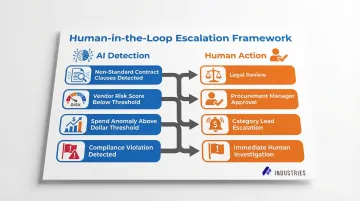
This division of labor allows AI to scale oversight across thousands of suppliers while preserving human judgment where it matters most.
Measure and Iterate
Define success metrics upfront—cycle time reduction, compliance rate, cost variance from contract terms—establish a review cadence, and continuously retrain models as vendor data grows and business rules evolve.
Track both leading and lagging indicators:
- Leading: AI agent accuracy, false positive rate, escalation volume
- Lagging: Contract value leakage, onboarding cycle time, maverick spend percentage
Monthly reviews identify where agents need recalibration, which processes require additional automation, and where human oversight rules should be adjusted. The goal is a system that gets measurably better each quarter—not one that's deployed and forgotten.
Frequently Asked Questions
How to use AI in vendor management?
AI applies across the entire vendor lifecycle. Common starting points include onboarding document validation with OCR, contract term extraction with NLP, continuous KPI monitoring with AI agents, and real-time compliance flagging against regulatory databases. Start with one high-friction use case, prove ROI, then scale.
What are the biggest benefits of AI in vendor management?
The most measurable benefits are:
- 25-40% reduction in manual workload through automated document and compliance tasks
- Proactive risk detection that prevents disruptions instead of reacting to them
- Data-driven spend visibility that supports strategic decision-making
Can AI replace human vendor managers?
No. AI handles repetitive, data-heavy tasks like document extraction, compliance monitoring, and KPI tracking at scale, but human judgment remains essential for complex contract negotiations, strategic relationship management, supplier dispute resolution, and governance decisions that require business context and discretion.
What is the difference between AI vendor management and traditional vendor management?
Traditional vendor management is reactive and manual: spreadsheet tracking, email-based document collection, and annual compliance audits. AI vendor management continuously monitors suppliers, predicts issues before they escalate, and shifts teams from administrative work to strategic relationship management.
How does AI improve vendor risk management?
AI continuously scans for financial instability signals (credit downgrades, bankruptcy filings), expiring certifications, compliance gaps (sanctions lists, GDPR violations), and ESG risks. The system assigns supplier health scores and issues early warnings, typically 60-90 days before issues become critical, rather than waiting for audits or incidents.
What challenges should companies expect when implementing AI in vendor management?
The three most common hurdles are poor data quality (duplicate supplier records undermine AI accuracy), integration complexity with existing ERPs and contract systems, and change management as teams adapt to new workflows. Organizations also need governance policies covering GDPR compliance and controls on unvetted AI tool adoption.