Introduction
Procurement workloads are projected to grow 9.8% in 2025 — while budgets grow just 1.6%. That gap is widening, and the numbers behind it are hard to ignore:
- 42% of procurement leaders cite supply disruptions as their top risk
- 73% of supply chain leaders experienced supplier disruptions in the past year, with 23% reporting significant revenue or cost losses
- 74% of procurement leaders admit their data is not "AI-ready"
Traditional automation was built for stable, predictable workflows. Modern procurement is neither.
The shift underway is fundamental. Procurement is moving from transactional automation (digitizing paperwork, automating clicks) to intelligent, autonomous execution. Agentic AI represents this new frontier — systems that set goals, plan multi-step tasks, and carry them out autonomously across the entire procurement lifecycle.
This guide explains what agentic AI is, how it differs from earlier AI approaches, the concrete benefits it delivers, real-world use cases already driving results, and how organizations can implement it responsibly without replacing their entire ERP stack.
Key Takeaways
- Agentic AI autonomously sets goals, plans multi-step workflows, and executes procurement tasks end-to-end—without waiting for human triggers at each step
- Delivers measurable impact: 19-21% lower operating costs, 58% shorter cycle times, and 25-40% efficiency gains
- High-value use cases include supplier selection, contract compliance monitoring, PO automation, demand forecasting, and autonomous sourcing
- Implementation works best with clean data, a phased rollout of 2-3 workflows first, and humans staying in the loop for oversight and decisions
- The most effective deployments let AI own execution at scale while humans focus on strategy, exceptions, and final judgment
What Is Agentic AI in Procurement?
Agentic AI represents a fundamental departure from traditional automation. While predictive AI forecasts outcomes and generative AI creates content, agentic AI is designed to act. It identifies goals, breaks them into tasks, and executes multi-step workflows with minimal human intervention.
The core architecture consists of AI agents powered by large language models (LLMs) that perceive data inputs, reason through trade-offs, and take action—often coordinating with other agents in a multi-agent system. McKinsey defines agentic AI as systems that "emulate human judgment, carry out multistep tasks, and continuously improve through learning loops"—operating as active decision-makers rather than passive reporting tools.
That distinction matters most when you compare it to what came before. Traditional systems like robotic process automation (RPA) follow fixed rules to handle repetitive tasks: entering invoice data, routing POs, updating spreadsheets. Agentic AI ingests complex, real-time datasets, reasons through changing conditions, and adapts mid-execution. Where RPA executes instructions, agentic AI makes decisions.
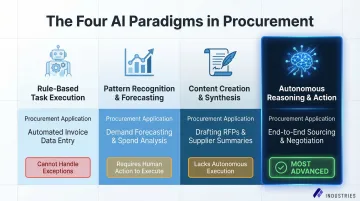
| AI Paradigm | Core Capability | Procurement Application | Limitations |
|---|---|---|---|
| RPA | Rule-based task execution | Invoice data entry, basic PO routing | Cannot handle unstructured data or exceptions |
| Predictive AI | Pattern recognition and forecasting | Demand forecasting, supplier risk scoring | Requires human intervention to act on insights |
| Generative AI | Content synthesis and creation | Drafting RFPs, summarizing contracts | Lacks autonomous decision-making and execution |
| Agentic AI | Autonomous reasoning, tool use, goal execution | End-to-end sourcing, dynamic negotiation, continuous compliance | Requires clean data and governance frameworks |
Agentic AI vs. Generative AI in Procurement
Generative AI and agentic AI serve different functions in procurement—and work best together. Generative AI handles content creation: drafting RFQs, generating contract clauses, building negotiation playbooks. Agentic AI handles execution: orchestrating sourcing events, monitoring suppliers, and routing approvals.
Example workflow: Generative AI drafts a supplier outreach email with optimized language and terms. An agentic AI agent sends it, tracks responses across multiple suppliers, evaluates bids against pre-set criteria, flags the top three candidates, and schedules follow-up meetings—compressing a process that typically takes days into hours.
Key Benefits of Agentic AI in Procurement
Cost Reduction and Efficiency Gains
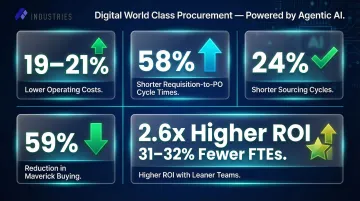
Digital World Class procurement organizations operate at 19-21% lower cost as a percentage of spend compared to their peers. McKinsey estimates that agentic AI can make procurement functions 25-40% more efficient.
These top performers achieve:
- 58% shorter requisition-to-PO cycle times
- 24% shorter sourcing cycles
- 59% reduction in maverick buying
- 31-32% fewer FTE staff while managing 21% more spend and delivering 2.6x higher ROI
Automating routine tasks (vendor onboarding, document validation, invoice reconciliation) frees procurement staff to focus on strategic supplier partnerships, category management, and new supplier development.
Proactive Risk Management
Supplier failures carry devastating costs. A suspected arson attack at a single German automotive plant resulted in a week-long power loss that cost the manufacturer over $111 million. Up to 25% of middle-market private companies cannot currently pay annual interest expenses from operating income, creating severe insolvency risks that traditional audits miss.
Agentic AI shifts procurement from reactive firefighting to proactive mitigation. Agents continuously monitor supplier performance, geopolitical signals, financial stability, and market conditions, processing external data streams that no human team could track manually.
Real-world example: Danone achieved 60% category coverage globally in one year using AI-powered visibility. During the Red Sea shipping blockage, the system identified impacted suppliers early, allowing Danone to proactively reroute shipments and minimize delays.
Better-Informed Decision-Making
Agents ingest and synthesize far more data than any human team can process. They combine spend history, market benchmarks, real-time supplier signals, and external risk factors to surface actionable recommendations faster and with greater accuracy.
A telecommunications company used AI agents to support price negotiations across long-tail software spend. The system evaluated trade-offs between cost, service levels, and risk, automatically generating counteroffers. This reduced negotiation team time spent on analysis and emails by up to 90%.
Enhanced Supplier Relationships
Offloading routine supplier onboarding, contract renewals, and compliance tracking to agents gives procurement professionals time back for the work that actually builds relationships: strategic partnerships, joint problem-solving, and collaborative innovation.
Digital World Class procurement functions dedicate 26% more workforce capacity to strategic tasks—spend analysis, supplier relationship management, stakeholder collaboration—than peer organizations.
Continuous Optimization Through Learning Loops
Agentic AI systems improve with use. Closed-loop feedback allows agents to refine sourcing strategies, negotiation approaches, and scoring models based on outcome data. Over time, the gap between predicted and actual outcomes narrows—each procurement cycle produces better inputs for the next.
Top Use Cases of Agentic AI in Procurement
Agentic AI is producing measurable results across the procurement lifecycle — from sourcing to settlement. These use cases represent the highest-ROI starting points for enterprise teams.
Supplier Selection and Evaluation
Agents autonomously analyze potential suppliers against historical performance data, financial stability indicators, compliance records, and market risk signals—surfacing shortlists and flagging high-risk vendors before human review.
A chemicals company piloting AI agents for autonomous sourcing in consumables automated tender preparation, supplier prequalification, and bid analysis. This increased procurement staff efficiency by 20-30% and boosted value capture by 1-3%.
Contract Management and Compliance
Poor contract management is a silent revenue killer. Organizations lose an average of 11% of contract value post-signature due to missed savings, unmanaged clauses, and unauthorized changes. Only 62.2% of enterprise spend is contract compliant, and maverick spend costs 12-18% more than compliant spend.
Agents automate contract reviews, track key terms and renewal dates, check invoice-to-contract compliance in real time, and alert teams to deviations. Organizations implementing AI-native contract lifecycle management typically achieve a 60-80% reduction in contract processing time and 40-60% improvement in obligation compliance rates.
Real-world example: A global pharmaceutical company deployed an AI-based invoice-to-contract reconciliation tool. In just a four-week proof of concept, the AI identified more than $10 million in value leakage, prompting immediate supplier renegotiations.
Purchase Order Automation
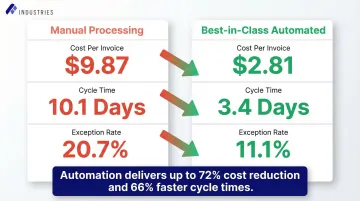
Manual PO processing remains a drain on procurement teams. The average organization spends $9.87 to process a single invoice, with data entry error rates of 1-5% compounding downstream costs. Agents generate, route, and approve purchase orders automatically based on pre-set criteria, inventory levels, and purchase history.
The performance gap between manual and automated processing is significant:
| Metric | Manual Processing | Best-in-Class Automated |
|---|---|---|
| Cost per invoice | $9.87 | $2.81 |
| Cycle time | 10.1 days | 3.4 days |
| Exception rate | 20.7% | 11.1% |
Demand Forecasting and Inventory Optimization
Inventory distortion—the combined cost of overstocks and stockouts—cost retailers $1.77 trillion globally in 2023. Traditional spreadsheet-based forecasting methods cannot process the complex variables that drive modern demand.
AI agents forecast demand by pulling together historical sales data alongside external signals: seasonal trends, macroeconomic conditions, weather patterns, and social sentiment. AI-powered forecasting can reduce supply chain errors by 20-50%, translating into a 65% reduction in lost sales from stockouts and a 5-10% reduction in warehousing costs.
Real-world examples:
- Walmart deployed AI-powered forecasting across 4,700 stores, resulting in a 16% reduction in stockouts and 10% improvement in inventory turnover
- Amazon utilized machine learning models to achieve a 35% reduction in stockouts across its fulfillment network
Sourcing and Negotiation Support
In sourcing, AI agents handle the analytical groundwork that used to consume weeks of team time:
- Conduct autonomous sourcing events and RFx processes
- Build pre-negotiation fact bases from market and supplier data
- Simulate demand under varying market scenarios
- Generate counteroffers and respond to supplier queries
A technology company employed linked AI agents to rebuild its strategy for sourcing external services. The agents simulated demand under various market scenarios, identifying savings opportunities of 12-20% in contact center operations and 20-29% in BPO spend.
How to Implement Agentic AI in Procurement
Start with Data Readiness, Not Technology
Agentic AI requires clean, connected, and accessible data. Organizations must prioritize breaking down data silos across spend, suppliers, contracts, and market benchmarks before deploying agents. Fragmented data is the most common reason implementations stall.
Currently, 21% of procurement leaders report data infrastructure maturity below 70%, with spend data scattered across multiple repositories. Gartner warns that over 40% of agentic AI projects will be canceled by 2027 due to poor data quality, unclear business value, or inadequate risk controls.
Build a common "data spine" that provides a single source of truth across spend, suppliers, and contracts before deploying agents.
Adopt a Phased, Use-Case-First Approach
Begin with 2-3 high-impact, well-defined procurement workflows rather than attempting enterprise-wide deployment. Good starting points include:
- Tail-spend repricing
- Invoice-to-contract compliance
- RFx generation and supplier outreach
- Vendor document renewal tracking
Prototypes can move to pilots in weeks and scale within a year. While 49% of procurement teams piloted generative AI in 2024, only 4% achieved large-scale deployment—avoid "pilot purgatory" by defining clear success metrics and scaling criteria upfront.
Build for Human-Agent Teaming, Not Full Replacement
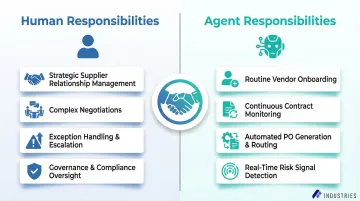
The most effective implementations define clear roles: agents handle execution, data synthesis, and scale; humans provide strategic direction, exception management, and governance oversight.
Human responsibilities:
- Strategic supplier relationship management
- Complex negotiations requiring judgment
- Exception handling and escalation decisions
- Governance and compliance oversight
Agent responsibilities:
- Routine supplier onboarding and document collection
- Continuous contract and compliance monitoring
- Automated PO generation and routing
- Real-time risk signal detection and alerting
The goal is reskilling, not replacement. When agents absorb routine execution, procurement teams can redirect capacity toward the supplier relationships and strategic decisions that actually drive value.
Accelerate with an Orchestration Partner
Organizations can accelerate implementation by working with an orchestration partner rather than assembling point solutions. Assembly Industries, for example, pairs AI agents with expert-vetted human oversight and SOC 2-compliant infrastructure. Their team handles workflow design, implementation, and ongoing performance monitoring — so enterprises don't have to manage the complexity themselves.
Assembly's procurement automation platform covers:
- Vendor onboarding via conversational AI (W-9s, COIs, certifications, and banking details in 74+ languages)
- Continuous document audit workflows
- Automated timesheet and billing verification
- Structured vendor scorecards and contract compliance review
- New vendor due diligence
Each engagement includes both the platform and an expert services implementation team — reducing the configuration burden on internal teams.
Challenges and Governance Considerations
Deploying AI agents in procurement delivers real efficiency gains, but it also introduces risks that can't be managed after the fact. Governance needs to be built into the design from day one.
Address the Real Risks
Three issues surface most often in enterprise deployments:
- Algorithmic over-reliance: Without sufficient oversight, AI agents can make suboptimal sourcing decisions or miss critical supplier risks. Procurement leaders must be able to audit how agents reached decisions, especially for high-value sourcing events.
- Training data bias: AI systems trained on historical procurement data can perpetuate existing supplier selection biases—favoring incumbents or filtering out suppliers based on characteristics unrelated to performance.
- Explainability gaps: Complex ML models don't always surface clear reasoning. Organizations must document each system's capabilities, limitations, and output uncertainty—even when full interpretability isn't achievable.
Implement a Responsible AI Governance Framework
Cover four key pillars:
Transparency:
- Document all automated workflows and decision logic
- Maintain comprehensive audit trails of agent actions
- Provide explainability for high-value decisions
Security:
- Implement AES-256 encryption for data at rest and TLS 1.2+ for data in transit
- Enforce role-based access control and multi-factor authentication
- Conduct regular vulnerability scanning and annual penetration testing
Human-in-the-Loop Safeguards:
- Define clear escalation points for high-value or high-risk decisions
- Establish override mechanisms for all automated workflows
- Integrate human review for sensitive commercial decisions
Bias Mitigation:
- Conduct regular dataset reviews for fairness
- Implement anomaly detection to flag unusual patterns
- Test supplier evaluation models for discriminatory outcomes
Navigate Global AI Standards
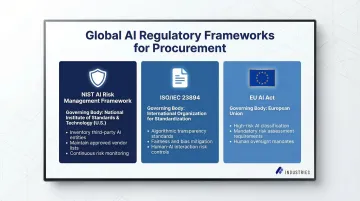
Internal governance frameworks also need to align with external regulatory standards. As procurement AI takes on more spend authority, compliance with the following frameworks becomes increasingly relevant:
- NIST AI Risk Management Framework: Mandates inventorying all third-party entities with access to organizational content and establishing approved AI vendor lists
- ISO/IEC 23894: Introduces AI-specific risk categories including algorithmic transparency, fairness and bias, and human-AI interaction risks
- EU AI Act: Classifies certain procurement systems as "high-risk," requiring adequate risk assessment, high-quality training datasets, detailed documentation, and appropriate human oversight
Evaluate Vendors Critically
Ask vendors specific questions to distinguish genuine agentic platforms from AI-labeled tools:
- Which workflows are truly AI-powered versus rule-based automation?
- How is the audit trail maintained for agent decisions?
- What override mechanisms exist for human intervention?
- How do you handle algorithmic bias in supplier evaluations?
- What data quality requirements must be met before deployment?
Frequently Asked Questions
What is agentic AI in procurement?
Agentic AI autonomously sets goals, plans multi-step tasks, and executes them across procurement workflows (supplier selection, contract compliance, risk monitoring) without human prompting at each step. Unlike passive automation or generative AI tools, it makes decisions and adapts strategies independently as conditions change.
What can AI be used for in procurement?
AI handles supplier selection and evaluation, contract management and compliance monitoring, purchase order automation, demand forecasting and inventory optimization, sourcing negotiations, and continuous risk assessment. Agentic AI executes these workflows end-to-end, with minimal human intervention at each step.
How is agentic AI different from traditional procurement automation?
Traditional automation like RPA follows fixed rules to digitize repetitive tasks: entering data, routing forms, updating records. Agentic AI reasons through complex, changing conditions, makes decisions autonomously, and adapts strategies mid-execution — functioning more like a digital procurement colleague than a rule-based bot.
Will agentic AI replace procurement teams?
No. Agentic AI is designed to augment procurement teams, not replace them. Agents take over execution, data synthesis, and routine monitoring so human professionals can focus on strategy, supplier relationships, complex negotiations, and judgment calls that require business context and empathy.
What are the biggest risks of implementing agentic AI in procurement?
The primary risks are poor data quality, lack of explainability in AI-driven decisions, algorithmic bias in supplier evaluations, and weak governance frameworks. Each can be addressed through data readiness assessments, phased rollouts starting with low-risk workflows, and human-in-the-loop oversight controls.