Introduction
Supply chain disruptions now cost enterprises an average of $184 million annually per company, contributing to a $184 billion global economic toll. McKinsey research puts the long-term damage in sharper focus: disruptions lasting one month or longer occur every 3.7 years on average, costing the typical organization 45% of a year's profits over a decade.
The problem isn't exposure to risk — it's the tools used to manage it. Legacy approaches (quarterly audits, spreadsheets, point-in-time assessments) can no longer keep pace with real-time disruption across complex, multi-tier global supply chains.
AI is reshaping supplier risk management by shifting procurement teams from firefighting disruptions to anticipating them. The shift works best when AI handles continuous monitoring and pattern detection while human judgment governs the decisions that follow — orchestration matters as much as automation.
Key Takeaways
- AI shifts supplier risk management from reactive to proactive by continuously monitoring thousands of signals across supplier networks
- Core capabilities include network mapping, sub-tier discovery, automated risk scoring, and continuous predictive alerting
- Organizations achieve 50-70% faster disruption detection, 20-40% reduction in emergency procurement costs, and 10-25% reduction in inventory carrying costs
- AI performs best alongside human judgment; the way you orchestrate automation determines how much value you actually capture
- Choosing the right solution means evaluating data coverage, model quality, integration depth, and vendor accountability for outcomes
Why Traditional Supplier Risk Management Is Failing
The Core Limitation: Periodic and Manual Processes
Traditional risk management relies on quarterly audits, spreadsheets, and point-in-time assessments that can't keep pace with real-time disruption. While 95% of organizations have visibility into their Tier-1 suppliers, only 42% can see into Tier-2 or beyond. That gap matters because most major disruptions originate in sub-tiers that traditional tools never reach.
When disruptions hit, procurement teams scramble to cover costs that compound fast:
- Expedited air freight and premium shipping costs
- Emergency sourcing at premium pricing
- Production downtime and idle facilities
- Reputational damage and customer penalties
The numbers behind these scrambles are steep. Fortune Global 500 companies lose $1.4 trillion annually to unplanned downtime, with automotive manufacturers facing costs of $2.3 million per hour offline. Responding after the fact typically runs 20-40% more than prevention would have.
The Hidden Sub-Tier Dependency Problem
Most procurement teams only see their Tier-1 suppliers clearly. Hidden sub-tier dependencies create single points of failure that manual processes routinely miss — for example, two separate Tier-1 suppliers quietly drawing from the same sub-component manufacturer. Most major disruptions start exactly there. Without n-tier transparency, procurement teams are managing risk they can't actually see.
The Major Categories of Supplier Risk Procurement Teams Must Manage
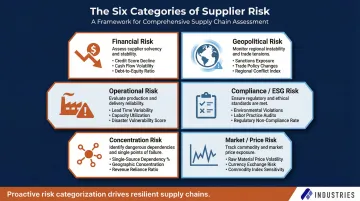
Effective supplier risk management requires understanding six distinct risk categories:
| Risk Category | Description & Key Indicators |
|---|---|
| Financial Risk | Supplier insolvency, bankruptcy, credit rating downgrades, cash-flow instability |
| Geopolitical Risk | Trade wars, tariffs, sanctions, regional conflicts, political instability |
| Operational Risk | Capacity constraints, natural disasters, extreme weather, delivery delays, cyberattacks |
| Compliance/ESG Risk | Human rights violations, forced labor, environmental degradation, regulatory breaches |
| Concentration Risk | Over-reliance on single-source suppliers or geographic clusters |
| Market/Price Risk | Commodity volatility, currency shifts, inflation impacts |
These risks don't occur in isolation. Geopolitical events trigger financial instability, which compounds operational risk. Geopolitical risk is now a top concern for 55% of businesses, up from 35% in 2023, while 82% of surveyed companies report that new tariffs affect their supply chains.
AI spots these interconnections across an entire supplier network simultaneously—something no manual review process can match at scale. That capability only delivers results when paired with the right risk framework: one that assigns different weights to each category based on the enterprise's industry, product criticality, and risk tolerance. AI-powered platforms allow procurement teams to configure these thresholds dynamically rather than applying uniform static scoring.
How AI Transforms Supplier Risk Management: Core Capabilities
Supplier Network Mapping and Sub-Tier Visibility
AI's first job is building a comprehensive digital map of the entire supplier network—including Tier-2 and Tier-3 suppliers—by processing trade records, shipping data, financial filings, and business relationship data at a scale no human team could replicate. This reveals hidden concentration risks and dependency clusters that manual processes overlook.
The $210 Billion Lesson: The Semiconductor Crisis
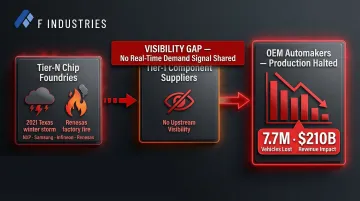
The 2020-2022 semiconductor shortage perfectly illustrates the catastrophic impact of sub-tier supplier dependency. The shortage cost the global auto industry an estimated $210 billion in lost revenues in 2021, resulting in the lost production of 7.7 million vehicles.
Automakers, reliant on Tier-1 suppliers for finished components, were blinded when Tier-N chip foundries failed. A severe winter storm in Texas shut down NXP, Samsung, and Infineon factories; a factory fire at Renesas in Japan further choked global supply.
Because OEMs had no visibility into these shared sub-tier dependencies, they couldn't proactively secure alternatives while capacity still existed.
Sub-Tier Discovery in Action
AI surfaces sub-tier risks that manual audits routinely miss. For example:
- Multiple direct suppliers routing through a single upstream manufacturer — a "diversified" base that's actually one point of failure
- Geographic clustering where five Tier-2 suppliers all operate within the same flood-prone coastal region
- Shared logistics providers creating a bottleneck invisible at the Tier-1 level
Automated Risk Scoring and Assessment
Once the network map exists, AI assigns a continuously updated risk score to every node in it. These scores combine internal performance data (delivery history, quality metrics, payment behavior) with external signals — news sentiment, financial health indicators, regulatory filings, ESG databases — and refresh in real time as conditions change, unlike static annual scorecards.
Key advantages:
- Enterprises weight risk factors to match their tolerance — a pharma company prioritizes compliance risk differently than a consumer goods firm
- Financial stability, geopolitical exposure, operational resilience, and compliance track records are scored simultaneously, not in silos
- Scores reflect both a supplier's absolute risk level and how critical that supplier is to your specific operations
Continuous Monitoring and Predictive Alerting
AI monitors thousands of data sources simultaneously—news feeds, government databases, weather data, financial markets, logistics signals—and surfaces only the alerts most relevant to that enterprise's specific supply network, filtering out noise that doesn't impact their operations.
The predictive layer: Machine learning models trained on historical disruption patterns can estimate the likelihood and potential impact of specific risk scenarios before they materialize, giving procurement teams time to act while alternatives are still available and affordable.
Important limitation: Predictive models cannot anticipate truly novel, unprecedented events—human judgment remains essential for black swan scenarios. AI excels at pattern recognition, not imagination.
The Business Benefits of AI-Driven Supplier Risk Management
Proactive Disruption Prevention and Cost Reduction
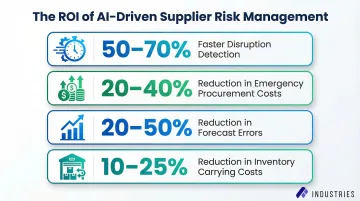
AI-enabled early warning systems give procurement teams days or weeks of lead time to respond—allowing them to pre-position inventory, identify alternate suppliers, or adjust production plans before a disruption forces emergency action. Organizations using risk-optimized, AI-driven procurement report a 50-70% reduction in the time required to identify and assess disruption impacts.
This speed advantage translates to cost savings. AI-driven predictive analytics deliver a 20-40% reduction in emergency procurement and expediting costs compared to reactive approaches. Organizations also report a 30% reduction in revenue losses stemming from supply disruptions.
Organizations that don't actively monitor supplier risk often carry excess buffer stock as a hedge against uncertainty. AI monitoring reduces the need for this safety stock, freeing up working capital. Machine learning models achieve a 20-50% reduction in forecast errors, translating into a 10-30% reduction in safety stock requirements and a 10-25% reduction in inventory carrying costs.
Enhanced Compliance and ESG Risk Management
AI continuously monitors the regulatory landscape—tracking changes to trade sanctions, labor laws, environmental regulations, and industry-specific compliance requirements—and flags suppliers that may be at risk of violations before they create legal or reputational exposure for the buyer.
The stakes are high. Since June 2022, U.S. Customs and Border Protection has stopped 65,707 shipments valued at $3.91 billion for UFLPA (Uyghur Forced Labor Prevention Act) enforcement. The EU's Corporate Sustainability Due Diligence Directive imposes fines of up to 5% of a company's net worldwide turnover for supply chain violations.
AI also automates ESG due diligence across supplier networks at a scale no manual audit team can match. Key screening areas include:
- Forced labor flags and human rights violations
- Sustainability certifications and carbon reporting status
- Ethical sourcing indicators and conflict mineral exposure
- Compliance with UFLPA, CSDD, and sector-specific ESG mandates
Smarter Supplier Selection and Strategic Sourcing
AI transforms supplier selection from a cost-first exercise to a risk-adjusted decision. Procurement teams can weigh a supplier's financial stability, operational resilience, compliance track record, and geopolitical exposure alongside price—optimizing for total value, not just unit cost.
AI-driven supplier profiling also accelerates the onboarding and qualification process, reducing the time it takes to approve new suppliers when primary suppliers need to be replaced during a disruption.
Faster Response and Reduced Disruption Impact
AI-integrated supply chains respond 30-40% faster to disruptions compared to traditional manual processes, driven by automated monitoring and instant alert generation. That response gap is the difference between containing a disruption early and watching it cascade through your entire supply network.
Human + AI Orchestration: Why the Combination Matters Most
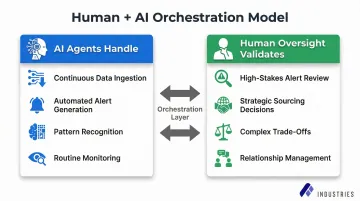
AI alone is not sufficient. AI excels at processing volume and identifying patterns, but experienced human judgment is irreplaceable for contextualizing ambiguous signals, making strategic trade-offs, and managing supplier relationships. The most effective supplier risk programs combine both.
What True Orchestration Looks Like
AI agents handle:
- Continuous data ingestion from thousands of sources
- Automated alert generation and risk scoring
- Pattern recognition and anomaly detection
- Routine monitoring and documentation
Expert human oversight validates:
- High-stakes alerts and removes false positives
- Strategic sourcing decisions and supplier negotiations
- Complex trade-offs between cost, risk, and resilience
- Relationship management and exception handling
Assembly Industries' model puts this into practice by combining AI agents with expert-vetted human oversight in a unified orchestration layer. Rather than deploying isolated AI tools, the platform delivers procurement process automation with full accountability for business outcomes. It integrates documented SOPs, specialized AI agents, human-in-the-loop oversight, SOC 2-compliant infrastructure, and real-time monitoring into one cohesive system.
Why the "Tools-Only" Approach Fails
Enterprises that deploy AI software without investing in process orchestration, workflow integration, and skilled human review often find that alert fatigue, data quality issues, and poor change management undermine their ROI. While 75% of respondents are planning, blueprinting, or piloting AI use cases, only 19% report deploying AI tools at scale. Most AI initiatives stall between pilot and production.
The problem? Up to 95% of generative AI initiatives struggle to deliver sustained ROI due to fragmented data, siloed systems, and undocumented workflows. Without orchestration, AI tools surface data — but they don't drive decisions or accountable action.
Evaluating and Implementing AI for Supplier Risk Management
Key Evaluation Factors
When evaluating AI supplier risk platforms, assess:
1. Data Coverage
- How many external sources are monitored (news, financial, regulatory, logistics)?
- How frequently are data sources updated (real-time vs. daily vs. weekly)?
- Does the platform cover sub-tier suppliers or only Tier-1?
2. Model Quality
- How is the AI trained and validated?
- How does the system handle uncertainty and novel scenarios?
- What is the false positive rate, and how are alerts contextualized?
3. Integration Depth
- Does it connect to existing ERP, procurement, and supplier management systems?
- Are integrations real-time or batch-based?
- How much manual data entry is required?
4. Human Expertise Layer
- Does the vendor provide expert validation or rely purely on automated outputs?
- Is there a clear escalation path for high-stakes decisions?
- Who is accountable for outcomes—you or the vendor?
Implementation Approach
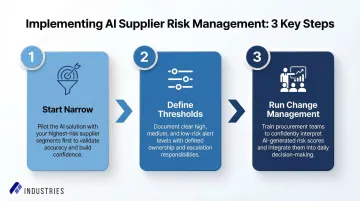
Start narrow. Pilot with your highest-risk supplier segments—critical suppliers or those in high-risk regions—before scaling to the full network. Proving value here first builds the case for broader rollout.
Define thresholds before go-live. Document what constitutes a high, medium, and low-risk alert, and assign clear ownership for each response type.
Run change management in parallel. Train procurement teams on interpreting risk scores and alert context so AI-generated insights drive action, not confusion.
Common Implementation Pitfalls to Avoid
- Treating AI scores as final verdicts — no algorithm is perfect, and high-stakes decisions still require human review
- Deploying the tool in isolation — insights that don't reach decision-makers inside existing procurement workflows get ignored
- Skipping upfront KPIs — define success metrics like disruption-related cost reduction, response time improvement, and compliance incident rate before deployment
Frequently Asked Questions
What can AI-powered procurement solutions do?
AI-powered procurement solutions automate supplier monitoring, generate real-time risk alerts, score and rank supplier risk profiles, map sub-tier supply networks, and provide predictive insights that allow procurement teams to prevent disruptions rather than react to them.
Which AI solutions are best for supplier risk management in procurement?
The strongest solutions combine broad external data coverage, configurable risk scoring, and deep integration with existing procurement systems. A human validation layer to reduce false positives is essential, as is a vendor willing to commit to outcome-based contracts and SLAs.
What are the main types of supplier risk in procurement?
The six primary categories are:
- Financial: insolvency, cash flow issues
- Geopolitical: tariffs, sanctions, political instability
- Operational: natural disasters, cyberattacks, capacity constraints
- Compliance: labor violations, ESG failures, regulatory breaches
- Concentration: over-reliance on single suppliers or regions
- Market/price: commodity volatility, currency shifts
AI platforms monitor all six simultaneously across multi-tier supplier networks.
How does AI predict supplier disruptions before they happen?
AI uses machine learning models trained on historical disruption patterns to identify early warning signals — financial stress indicators, weather events, regulatory changes — and estimate their likely impact. This gives procurement teams days or weeks of lead time to act before a disruption materializes.
What is the difference between AI and traditional supplier risk management?
Traditional supplier risk management relies on periodic, manual audits and point-in-time assessments that quickly become outdated. AI provides continuous, real-time, multi-tier monitoring that shifts procurement from reactive firefighting to proactive risk mitigation at scale, with 50-70% faster disruption detection.
How do you measure the ROI of AI in supplier risk management?
Key ROI metrics include reduction in revenue loss from supply disruptions (typically 30%), faster disruption response time (50-70% improvement), decrease in excess buffer inventory (10-30% reduction in safety stock), reduction in emergency procurement costs (20-40% savings), and improved supplier quality scores over time.