Introduction
Most organizations have a hiring process but not a talent strategy. When a critical role opens, they start from scratch—losing weeks to sourcing, screening, and outreach. According to SHRM's 2025 benchmarking data, the median time-to-fill sits at 45 days for both executive and nonexecutive positions, stretching to 60 days in organizations with 5,000+ employees.
That delay carries a real price tag. SHRM reports that replacing an employee can cost 50% to 200% of their annual salary—a figure that compounds quickly when multiple roles are open at once.
This guide is for HR managers, talent acquisition leads, and people operations teams in enterprise or growth-stage organizations who want to move from reactive hiring to a proactive hiring strategy. By the end, you'll have a clear framework for building and maintaining talent pools that keep your pipeline full before you ever post a job.
Key Takeaways
- Talent pool management eliminates the cold-start problem in recruiting by maintaining a pre-vetted, pre-engaged group of candidates
- It cuts time-to-hire, lowers cost-per-hire, and improves candidate quality—without starting each search from scratch
- Success depends on consistent engagement, skills tracking, and defined activation workflows, not just a static database
- Candidates disengage within weeks without meaningful contact, making regular outreach non-negotiable
- Automation and AI tools now handle pool management at scale without overburdening HR teams
What Is Talent Pool Management?
Talent pool management is the practice of identifying, organizing, and nurturing relationships with qualified candidates—inside and outside the organization—who fit current or future roles. When a vacancy opens, HR has a pre-vetted, pre-engaged shortlist ready to act on rather than starting a search from zero.
Critical distinctions:
- Talent pool: The broader reservoir of candidates across multiple roles and functions
- Talent pipeline: A narrower, role-specific funnel actively moving toward hire
- ATS: A tool for managing candidates, not a strategy itself
A talent pool is the curated group you nurture over time. A pipeline is the active subset you're moving through interview stages right now. Your ATS stores the data—but without a deliberate management strategy behind it, that data stays inert.
Why Talent Pool Management Matters for HR
The Pressure Driving Adoption
Labor market volatility, skill shortages, and competition for specialized talent mean organizations who wait until a role opens are already behind. As of 2025, 69% of organizations report difficulty recruiting for full-time regular positions, even as the U.S. market shows 6.9 million open jobs. When you start from scratch, you're competing for the same scarce talent everyone else is chasing.
What HR Operations Demand
Talent pool management addresses specific operational needs:
- Gives you qualified candidates ready when strategic initiatives launch
- Cuts dependency on job boards and expensive agency fees
- Accelerates staffing timelines for business-critical roles
Without it, reactive hiring leads to compromised decisions, inflated costs, and extended vacancy periods. SHRM data shows median cost-per-hire for executive roles has surged 113% since 2017 to reach $10,625, with average costs hitting $35,879. Reactive searches drive these numbers higher through rushed decisions and premium sourcing fees.
The Internal Talent Dimension
A well-managed pool includes existing employees eligible for lateral moves or promotion. The retention impact is measurable:
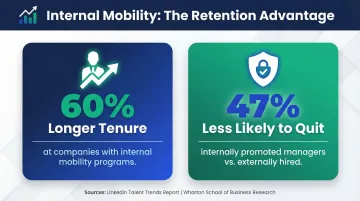
- Employees at companies with internal mobility programs stay 60% longer than those at organizations without them
- Internally promoted managers are 47% less likely to quit than their externally hired counterparts
Talent pool management spans recruitment marketing, workforce planning, and learning and development. For enterprise HR teams, it's become standard operating practice — not a nice-to-have.
How Talent Pool Management Works
Talent pool management is a continuous cycle, not a one-time initiative. It runs from identifying who belongs in the pool, through ongoing engagement, to activating candidates when need arises, and then feeding outcomes back into the system.
Step 1: Build and Segment the Pool
Populating the pool draws from multiple sources:
- Previous applicants who scored well but weren't selected
- Internal employees flagged for growth or mobility
- Employee referrals and alumni networks
- University pipelines and passive candidates identified through sourcing
Segmentation is essential. A pool segmented only by job title becomes difficult to activate. Effective segmentation includes:
- Role type and skill cluster (e.g., "data engineering," not just "engineer")
- Seniority level (individual contributor vs. manager vs. director)
- Readiness status (actively looking, open to opportunities, long-term prospect)
- Geographic location and work authorization
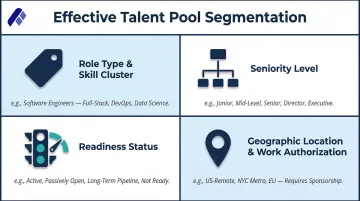
This transforms your pool from a contact list into a searchable, actionable asset.
Step 2: Nurture and Engage Candidates
Candidates in a talent pool must receive regular, relevant touchpoints to stay warm. This includes:
- Role-relevant content and industry insights
- Company news and culture updates
- Event invitations and networking opportunities
- Personalized outreach from recruiters or hiring managers
Cadence and content should vary by segment. Internal high-potentials may receive quarterly career development check-ins, while passive external candidates might get monthly industry newsletters.
At scale, manually managing this outreach is unsustainable. Intelligent workflow automation can handle routine nurture sequences, status tagging, and follow-up triggers, freeing HR professionals to focus on relationship-building and judgment calls. Platforms like Assembly Industries combine AI-orchestrated workflows with human oversight to manage nurture sequences at scale without losing the personal touch that keeps candidates warm.
Those personal touchpoints matter more than ever. Gem's 2025 recruiting benchmarks show engagement rates declining across the board — evidence that generic outreach is losing ground:
Engagement metrics from Gem's 2025 benchmarks:
- Email open rates: 81% (down from 84% in 2023-2024)
- Reply rates: 23% (down from 26%)
- Interested rates: 13% (down from 15%)
These declining rates underscore the importance of segmentation and personalization. Generic bulk outreach no longer cuts through.
Step 3: Activate and Measure
When a role opens, HR queries the segmented pool to generate a shortlist rather than launching a cold search. Candidates are moved into the active pipeline, assessed against current role requirements, and either progressed or returned to the pool with updated notes.
Tracking metrics turns a talent pool into a strategic asset:
- Pool-to-hire rate: What percentage of hires come from the pool vs. external sourcing?
- Time-to-shortlist: How quickly can you generate qualified candidates?
- Engagement decay rate: At what point do candidates stop responding?
Data shows that sourced candidates are five times more likely to be hired than inbound applicants. The proportion of sourced hires rediscovered within a company's existing CRM or ATS rose from 29.1% in 2021 to 44.0% in 2024—proof that mining existing pools works.
Key Factors That Affect Talent Pool Management
Data Quality and Recency
The quality and recency of candidate data—skills, availability, career goals—directly determines whether the pool produces usable shortlists or outdated noise. Static spreadsheets and neglected ATS records are among the most common reasons pools fail.
The workforce is highly mobile. According to the Bureau of Labor Statistics, median tenure for wage and salary workers was just 3.9 years overall in January 2024, with notable differences by sector:
- Public sector: 6.2 years
- Private sector: 3.5 years
- Leisure and hospitality: 2.1 years
With 3.1 million workers quitting their jobs in January 2026 alone, a passive database becomes obsolete in a matter of months.
Segmentation Logic
Pools segmented only by job title rather than skills, readiness, and interest level are difficult to activate effectively. Advanced segmentation allows you to query for "senior data engineers with Python and AWS experience who are open to remote roles and have expressed interest in fintech"—not just "engineers."
Engagement Frequency and Relevance
Pools decay when outreach is generic or infrequent. Candidates typically disengage within 30–90 days without meaningful contact. Regular, relevant touchpoints keep them warm—and prevent you from losing candidates you spent time sourcing.
Technology Infrastructure
The tools you use determine how far the program can scale. An ATS with pool management features, a dedicated candidate CRM, or an AI-powered talent intelligence platform each handle volume and accuracy differently. Manual spreadsheet management collapses once you're tracking hundreds of candidates.
Organizational Commitment
Talent pool management requires cross-functional input:
- Hiring managers define role criteria and assess candidate fit
- Learning & Development supports internal candidate development
- HR leadership funds and prioritizes the function
Without that alignment, the pool becomes a recruiting team side project rather than a strategic capability.
Common Mistakes and Misconceptions
The "Database = Strategy" Misconception
The most damaging misconception is that a talent pool is simply a database. The database is the container, not the practice. Many HR teams build a list, add it to their ATS, and consider the job done. In reality, the pool only creates value through active management, consistent engagement, and regular data hygiene.
What Happens When Engagement Stops
Pools that go without engagement for more than a few months see steep candidate drop-off and data decay. Teams usually discover this only when they try to activate the pool — and find that candidates have moved on, changed contact details, or accepted roles elsewhere. The investment in building the pool evaporates the moment you need it most.
Ignoring Internal Talent
Many organizations make one of two opposite mistakes with internal talent:
- Ignoring it entirely — focusing only on external pipelines and missing internal mobility opportunities
- Prioritizing it without infrastructure — no systematic way to track skills or readiness, so high-potential employees get passed over when roles open
A complete talent pool strategy integrates both. Internal and external candidates belong in the same system, managed with the same rigor.
When Talent Pool Management May Not Be the Right Fit
Talent pool management creates more overhead than value in specific scenarios:
- Low hiring volume: Organizations hiring 2-3 people per year typically get better ROI from just-in-time sourcing than maintaining a standing pool
- C-suite and executive searches: Retained search partners outperform internal pools for highly specialized leadership roles
- Tightly regulated industries: Some sectors restrict how long candidate data can be retained without active consent, making pool maintenance legally complex
Signal that talent pool management is being used by default rather than by design:
- The pool is never actually queried when roles open
- No one owns engagement cadences
- The pool has not generated a single hire in over 12 months
If any of these apply, audit whether the investment in maintenance is generating measurable hiring outcomes before expanding the practice.
Compliance constraints add another reason to pause — in some environments, maintaining a talent pool isn't just operationally expensive, it's legally risky.
Compliance and Data Retention Constraints
Organizations cannot legally retain candidate data indefinitely. Regulatory frameworks impose strict limits:
- UK GDPR (ICO): Employers should not keep recruitment records for unsuccessful applicants beyond the statutory period in which a claim may be brought
- France GDPR (CNIL): To maintain a candidate pool, recruiters should request consent. Retention should not exceed two years from last contact
- California CCPA/CPRA: Privacy rights apply to job applicants. Businesses must limit collection, use, and retention to reasonably necessary purposes
Any talent pool that lacks automated data-deletion triggers and re-consent workflows is a liability waiting to surface — especially as regulators increase scrutiny of how companies handle applicant data.
Frequently Asked Questions
How do you manage a talent pool?
Managing a talent pool involves three ongoing activities: keeping candidate data current and segmented, running regular engagement touchpoints to keep candidates warm, and activating the pool systematically when roles open rather than treating it as a passive database.
What is the purpose of a talent pool?
The purpose is to give HR a pre-vetted, pre-engaged group of candidates to draw from when a vacancy arises, reducing time-to-hire, lowering cost-per-hire, and improving the quality of hiring decisions.
What does talent pool mean in business?
In a business context, a talent pool is the curated group of internal and external candidates an organization actively maintains relationships with for current and future hiring needs. Unlike a passive resume database, this group is engaged and ready to act on.
What does talent management do?
Talent management covers the full HR lifecycle: attraction, development, retention, and succession planning. Talent pool management is a specific practice within that function, focused on candidate sourcing and readiness.
Is joining a talent pool worth it?
Yes — being in a talent pool can accelerate consideration for future roles, especially at organizations that actively maintain theirs. Candidates should respond to employer outreach promptly and keep their contact details and experience up to date.
What are the 4 pillars of talent management?
The four pillars are recruitment and acquisition, learning and development, performance management, and succession planning. Talent pool management sits primarily within the recruitment and succession pillars.